
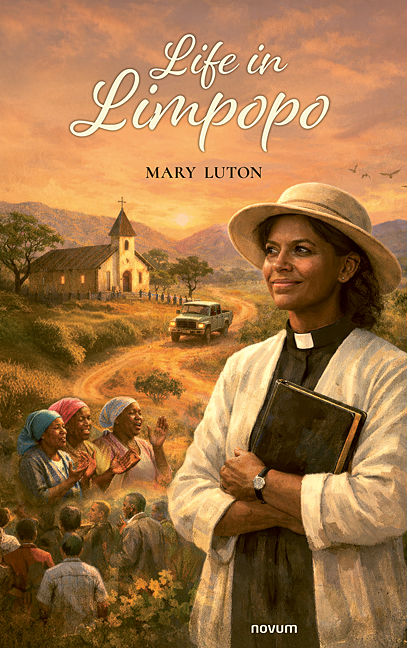
Life in Limpopo
GBP 16,90
Format: 13.5x21.5
Number of Pages: 102
ISBN: 978-3-7116-1096-6
Release Date: 31.08.2026
Limpopo, South Africa, early 2000s. When Stella accepts a new pastoral role in a rural community, she finds herself navigating village roads, muddy paths—and a new life. A plethora of characters enrich the story with their personal struggles and humanity.
1. Stella
It was a warm afternoon in late January. As Stella Malan drove to her rector’s home, she pondered over the phone call which had made her re-arrange her plans. The roads were not busy on a Saturday. Most people had already done their shopping, or work, and were taking part in sports, or watching, or relaxing at home. As was her custom, Stella kept an eye open for any wildlife. The road wound through several private game reserves, so she often saw buck, or zebras or had to stop to avoid baboons on the road.
Stella had moved to Bela Bela in Limpopo with her husband four years earlier. They were working as pastoral counsellors in a drug and alcohol rehabilitation centre, a rewarding but demanding job. When the centre collapsed due to financial pressures, they moved into the town, where Stella began teaching in a local private school, while both continued to assist with taking services in the Anglican parish. Her husband had been disabled, suffering from constant kidney infections, and then developed diabetes and heart problems. He died during their first year in Bela Bela town, leaving Stella alone in the house which they had bought with the help of her parents.
‘Hello, Stella,’ the rector had said. ‘You know I have been battling with my health lately.’
That was an under-statement. The poor man had cancer, and had been trying to battle on manfully, running a rural parish consisting of eleven churches. In recent months, she had been called upon to do more services, as he was unable to cope.
‘Yes, Paul,’ she said, keeping her tone neutral.
He swallowed hard. ‘We need to have a meeting urgently, with the Bishop. Can you be at my house at 2.00 p.m. on Saturday?’
She arrived, about two minutes late, to find fellow clergy already assembled: the newly ordained Anna from Brazil, newcomers Jill and Bill, who had recently retired in the area, and were willing to help out in the parish. The other two retired priests were not there. Bishop Mark joined them soon afterwards. The lay ministers were gathered separately, under the trees in the church yard.
Bishop Mark began with a prayer, and then launched into an explanation. Paul had battled his disease with courage, but his doctor had now told him that he had to give up work with immediate effect. He needed to appoint a priest in charge, and would prefer to appoint one of the local priests.
All eyes turned to Stella. Each one gave feedback on his or her availability, and the bishop continued, ‘It seems to me that Stella is the one we should appoint.’
Anna’s face lit up and she clapped her hands, ‘Yes!’ she cried.
‘How do you feel?’ Bishop Mark said to Stella, with a smile.
Stella swallowed hard. ‘All right. Yes, I am willing,’ she replied. She had known that this was a possibility, but now that it had happened, she felt excited, apprehensive and a little shocked. The fact that all those present seemed to agree that this was the best option reassured her. Bishop Mark then suggested that they should go outside, and join in the discussions with the lay ministers.
There were about fifteen of them, most of them unknown to Stella, as she had only been to two of the chapelries involved. St Andrew’s Bela Bela was in the township of Bela Bela, and St Stephen’s Phahameng was in the township of Modimolle. Although apartheid had been gone for fifteen years, the country towns were still divided into town (the original white areas) and township – where most of the black people lived, generally in smaller houses.
In that area of Limpopo, the Anglican church served black parishioners mostly. There was a white Anglican congregation in Bela Bela years before, but the church had been sold to the Seventh Day Adventists, and any Anglicans who still lived in the town joined the Warmbaths Methodist Church, which still had a strong congregation. Stella felt a deep seated resentment against the previous generation of Anglicans who had sold the property, as it would have been a very convenient place for her to conduct ministry, being located two blocks from her home.
Modimolle was different. St Michael’s Church had originally been the Anglican Church, and had celebrated its centenary in 2007. It was an attractive, thatch-roofed building. In the 1990s, the Anglican and Methodist churches had combined to form St Michael’s United Church. The rectory had remained an Anglican property, and therefore an odd situation developed where the rector of the Anglican Parish of St Andrew’s lived in the house next to the United Church, which was looked after by the Methodist Minister based in Bela Bela. There were inevitable tensions between different groups involved.
When they were all together, clergy and lay ministers, the Bishop organized the larger group to form their chairs in a circle, and explained the whole situation once again. He then said, ‘After discussing this with your clergy, I would like to appoint Stella as priest in charge of the parish.’
To Stella’s relief, this was met with murmurs of approval. One man asked if she would be involved in all the chapelries. Apparently, there had been a lively discussion before, with speculation about what would happen, and how they would go forward.
Stella hesitantly asked if she should ‘go for a walk’ while they discussed her appointment.
Ben, an elderly lay minister from Bela Bela spoke up. ‘No,’ he said. ‘We are happy. We all know Stella.’
The Bishop invited Stella to speak, and she gave what she hoped was a helpful speech, about how they would all work together and build up the parish. Then she asked them to pray for her, and promised to pray for all of them. The meeting ended with all of them praying, first for the outgoing rector, and then for the newly appointed priest in charge.
Before the meeting completely broke up, Bishop Mark introduced Stella to Jacob, a long-standing lay minister, who offered to help her in any way, and to travel with her to the far-flung chapelries and direct her.
Stella had promised to let the minister at Warmbaths Methodist Church and his wife know about the outcome of the meeting. On arriving home, she dialled the number of the manse. Jan was Polish, as he explained, a product of the revival which took place in Poland following the collapse of the Iron Curtain. He had been a Roman Catholic priest, and was sent to South Africa, where he met a blonde Afrikaans lady, the vivacious Hettie, and eventually left the Catholic Church to marry her. They had an infant son.
Hettie answered the phone. ‘Hello, Stella. So, who did they appoint?’
‘Me, actually,’ said Stella with a chuckle.
Hettie was delighted. ‘God is so good!’ She exclaimed.
Stella told her that she would be at their service in the Methodist Church the next day.
Next, she phoned her good friends in Bela Bela, Sylvia and Caroline. They were several years older than Stella, Sylvia a retired nursing sister, at one time the matron of a hospital, with a very dominant personality, but a kind and generous heart. Caroline was a few years younger, and had worked on the Johannesburg Stock Exchange for many years, before contracting lung cancer and taking early retirement. She had made a remarkable recovery, was officially in remission and had been so for over ten years. Caroline was an incredible cook, and enjoyed acting as hostess, whenever her health allowed. When Stella’s husband had died, Sylvia was among the first visitors who came to support her, and insisted that she have lunch with them the next day. After this, she became a frequent caller at their flat.
Both ladies were strong leaders in the Methodist Church, with Sylvia being the Society Steward, and Caroline working the sound system, and training younger people to do so as well.
Sylvia was not impressed when Stella told her that she had been appointed priest in charge.
‘I don’t know what to say,’ she blurted out.
They agreed to meet at the Methodist service the next day.
The service was well attended. Most people who had heard about her appointment seemed genuinely pleased and congratulated Stella. Some were more cautious, advising her not to take on too much work. Jan, the minister, and his wife seemed especially pleased.
After sharing coffee and cake with fellow worshippers in the church hall, Stella returned home to prepare her lessons for school the next day. She knew that it was going to be difficult to continue as a teacher, and still run the parish, but she was determined to make a success of it.
As she walked home after the school day on the Monday, Stella realized that her life would now follow a new pattern – school, a brief lunch break, preparation time and time for church administration or ministry tasks, before going around to Sylvia and Caroline in the early evening. Time off would have to be budgeted for in advance.
She phoned Paul at the St Michael’s rectory. ‘You’ve just caught me,’ he panted, to her horror. ‘I’m leaving now. Anne is in the car with the engine running. Speak to Jacob, he has keys to the office. If you go through the filing cabinets, you will find what you need. You have my number, call me in a few days. Sorry, goodbye.’
She contacted Jacob, who was very keen to help, and they agreed to meet the next afternoon, to go through the contents of the sparsely furnished rondawel office.. Most of the files were of historical interest, but did not help Stella in her short-term tasks and responsibility.
She decided that the first task must be to set up a service rota, involving all the part-time priests, and retired clergy, and all the chapelries, and set to work on this as soon as she reached her home. She also arranged to start with the first service in one of the rural churches the next Sunday. Jacob agreed to meet her outside St Michael’s at 7.00 a.m.
That first Sunday in February, she was up early and drove along the almost-deserted road, through the hills, to Modimolle. The town of Modimolle had the Afrikaans name Nylstroom (Nile Stream). The reason is that the original Afrikaans pioneers, the Voortrekkers, who travelled up from the Cape Province by ox wagon, saw the pyramid-like mountains in the distance, and the river, and decided that they had reached Egypt and this river was the Nile. They did not have an extensive knowledge of world geography in the 1830s!
Along with most towns in Limpopo, the town had been re-named after the ANC came to power. It was called Modimolle after a hill outside the town from which local tribesmen had once thrown condemned prisoners. Not a very cheerful association.
As a result, whenever she attended meetings and other gatherings in Modimolle, Stella would phone her friends Sylvia and Caroline to let them know she was back. Sylvia was some years older than Stella, and liked to play the role of mother, being very concerned for Stella’s safety. When Stella made the required phone call, she would usually begin ‘I have returned from the Source of the Nile and Place of Execution.’
On this occasion, she parked her car in front of St Michael’s Church. There were no other cars, as the service there would be held an hour and a half later. Eventually, Jacob arrived, smiling brightly, looking tall and distinguished, dressed in a suit, and carrying a black case containing his books and robes. He had travelled with priests since he had been a server as a young boy. He therefore proved invaluable to Stella, as he knew everyone and every place.
She soon learned that services in the far-out churches were run a little differently from those she was used to. When they arrived at the first church, Jacob asked her where the chalice was. He was most surprised that she did not know that they had to carry everything from place to place. So, both services on the first Sunday were Morning Prayer. Once home again, Stella put together a travelling kit, a metal tray which would hold the chalice and paten, wrapped in a cloth, as well as a bottle of red wine, and a plastic container filled with communion wafers. Sometimes as they drove, they would hear a loud clunk from the boot, and knew that the chalice had been thrown onto another hard object. She was pleased to find that it was quite robust and suffered little real harm.
There was a time when the chalice had been accidentally exchanged for another one, after a shared communion. One of the other parishes had taken the chalice from Modimolle, and left Modimolle with another parish’s chalice. They managed to find their own chalice again eventually, but it was very misshapen when it returned. It looked as if the neck was bent. A skilled workman employed by Stella’s parents was able to repair it, so that it looked as good as new.
Stella was a little daunted at the state of the gravel roads, and at one point said to Jacob, ‘Is it much further?’
‘Yes,’ he replied cheerfully.
She was grateful that he knew the roads so well.
After the second service, during which a severe African rain storm had swept across the so-called Springbok Flats, they set off home again. Jacob directed her to turn down a muddy road, and they soon found themselves well and truly stuck in the thick mud. He phoned a member of the congregation, who came out and met them, but was not able to pull the car out of the puddle. He sent for a tractor to do the job.
Stella was anxious, and found the casual attitude of the men hard to take. She was vaguely aware of the sound of a small stream bubbling along close to the edge of the road. She took out her mobile phone and called the AA. To her dismay, the telephonist asked, ‘Where is Seabe?’
A larger car came along in the opposite direction. Several men piled out, attached ropes and managed to pull the car onto hard ground. They refused any offer of money or other gifts, and drove off cheerfully. Stella soon learned that the code followed by those who travel on these suspect country roads is this: if you see someone in trouble, stop and offer help.
She turned the car around, and they retraced the way they had come, back to the tarred road. Stella let out a restrained cheer. By this time, it was almost 2.00 p.m., and they still had an hour to travel before they reached their homes. She took Jacob home, and then phoned her friend Sylvia. ‘Sorry,’ she said. ‘I am not going to make it for lunch.’
The general pattern was that she would meet Jacob outside St Michael’s Church at about 7.30 am – he very seldom arrived at 7.00 – and therefore she would leave home at 7.00. They would then travel on a round trip of approximately 100 km, incorporating two church services in different villages. Generally, Stella would be home about 1.00 p.m., but on certain occasions, when one of the services was longer than expected or there were problems on the roads, it was much late, perhaps 4.00 p.m.
Meanwhile, Sylvia would have enjoyed a relaxed afternoon, and would then phone Stella asking if she would like to attend a service at 6.00 p.m. with her, either at the Dutch Reformed Church or the Neo-Pentecostal church in Bela Bela. If she had not been out too late in the morning, Stella would join Sylvia but as time went on, she was often too tired to face another church service.
An additional factor for consideration was that most of these evening services were conducted in the Afrikaans language. Stella had a fair grasp of the language, having studied it at school, and used it more often since she came to live in Bela Bela. However, concentrating on a service in another language when one is already tired was at times too much.
On one occasion, Stella’s parents were visiting from Johannesburg. When asked if they wanted to join the service at the Dutch Reformed Church in the evening, her father replied, ‘No, thanks. We’ve already had two services in a different language today.’
After a brief rest and lunch, Stella settled down to go through her school lessons for the next day. Years later, she would wonder how she managed, effectively, to do two full time jobs for five years. In the sixth year, she was able to move to a part-time teaching post, and finally to withdraw from teaching altogether after seven years.
There was an additional problem – a local gentleman of the road who discovered where Stella lived, and would often watch for her to come home, usually in hiding. He would be there before she had unpacked the car.
‘Stella! Stella!’ his rasping voice cried. ‘It’s Joe.’
She would usually make him a sandwich and coffee, unless she was exceptionally tired. If she refused, he went away scowling, muttering as he marched down the long, stony driveway to the road.
Some of her neighbours were not happy that she was prepared to feed him, but Stella did feel that she should help, as a Christian and a clergy person. At one time, the iron gates between the complex and the road were kept locked. Joe proved very resourceful – he found that he could climb over the fence of the property next door and then climb across into the complex. Thereafter, the familiar, rasping voice would be heard, ‘Stella, Stella! It’s Joe. It’s Joe.’
Joe was plainly intelligent, and his English was very good. When he was locked outside, Stella would pass a mug of tea and a sandwich through the gate.
‘I wish to enter,’ he said.
‘Well, we don’t want you to enter,’ she replied. ‘You can just put the plate and cup through the bars when you are finished.’
He could be annoying, especially if she was very tired, after a heavy day. She also made a point of not feeding him more than once a day – he did try to ask, at one time. When he had decided to be really difficult, one day, he asked for ‘tea only.’ Then, he wanted a sandwich. She gave it to him, not very graciously. When he pushed the cup through the bars, saying, ‘Now I need more tea,’ she replied. ‘This restaurant is closed,’ and firmly closed her front door.
It was quite useful when there was only one car on the property, as it would be in the garage, and Joe would not be able to tell whether she was home or not, by looking at her house from the road. When there was a car parked outside, there was a good chance that she would receive a visit.
About once a week, she would pay him to wash a car, but he would want to wash a car every day, and this was completely unnecessary. Attempts had been made in the past to refer him to social workers and other aid agencies, but he obviously found begging more appealing. He was well known in the town, as he walked from one end to the other, and had regular clients. He would also ask for clothes from time to time. Stella soon learned that the Dutch Reformed Church gave out old clothes on weekday mornings, so she would reply to these requests by sending him to them. Sylvia was very irritated if she came around and found Joe on the premises. On occasion, she had literally chased him away.
Stella enjoyed walking around the town, and found that she could often carry out visits to local shops and businesses on foot. There were a few people who she would meet and greet at the roadside. One of these was a woman with a learning difficulty, named Hannah. She lived in a converted garage across the main road from Stella’s home, for a low rent. She used to sell hand crafted materials, and accost people in the street, trying to sell her wares. This made her very unpopular in the community. Some people simply responded to her requests with a sharp ‘No!’ Others would listen politely, and sometimes she was successful.
It was not long before Hannah attached herself to Stella and her dog. She would come to the door, calling out in a high pitched voice, ‘Stella! Shall we go and walk with the doggie?’
Usually, Stella would agree, and they would walk around the block, and then she would offer Hannah some tea.
Generally, this worked well. There was a little upheaval when Hannah suggested that they should eat their dinners together at 5.00 p.m. Stella protested that she only ate lunch after 2.00 p.m., when she came in from school. They tried this a few times, but soon gave up.
Hannah had been in an abusive marriage, and had a grown daughter who lived with Hannah’s parents, also in the town. She wanted to meet another man, and part of her strategy was to join many different churches, in the hope that a suitable man would be there. So, she used to attend services in the Methodist, Seventh Day Adventist, Dutch Reformed (2 congregations), Full Gospel, and Pentecostal churches.
When Stella’s parents were coming to visit and spend a weekend there, Hannah was told that they would come on Saturday. Hannah was very keen to meet them, so much so that she began to invent excuses to come over from 7.00 a.m. on the Saturday morning. There were frequent visits throughout the day, but it was well into the afternoon when they finally arrived.
Stella and her parents soon learned to dread the shrill calls and banging on the door.
At one stage, Hannah was having to rub cream on large areas of her body, and she asked Stella’s elderly neighbour to help her by rubbing it into her back. Aunt Poppy, as she was known in the community, did not mind helping Hannah, until Hannah ran across the busy road between the houses dressed in a very flimsy night gown.
...
It was a warm afternoon in late January. As Stella Malan drove to her rector’s home, she pondered over the phone call which had made her re-arrange her plans. The roads were not busy on a Saturday. Most people had already done their shopping, or work, and were taking part in sports, or watching, or relaxing at home. As was her custom, Stella kept an eye open for any wildlife. The road wound through several private game reserves, so she often saw buck, or zebras or had to stop to avoid baboons on the road.
Stella had moved to Bela Bela in Limpopo with her husband four years earlier. They were working as pastoral counsellors in a drug and alcohol rehabilitation centre, a rewarding but demanding job. When the centre collapsed due to financial pressures, they moved into the town, where Stella began teaching in a local private school, while both continued to assist with taking services in the Anglican parish. Her husband had been disabled, suffering from constant kidney infections, and then developed diabetes and heart problems. He died during their first year in Bela Bela town, leaving Stella alone in the house which they had bought with the help of her parents.
‘Hello, Stella,’ the rector had said. ‘You know I have been battling with my health lately.’
That was an under-statement. The poor man had cancer, and had been trying to battle on manfully, running a rural parish consisting of eleven churches. In recent months, she had been called upon to do more services, as he was unable to cope.
‘Yes, Paul,’ she said, keeping her tone neutral.
He swallowed hard. ‘We need to have a meeting urgently, with the Bishop. Can you be at my house at 2.00 p.m. on Saturday?’
She arrived, about two minutes late, to find fellow clergy already assembled: the newly ordained Anna from Brazil, newcomers Jill and Bill, who had recently retired in the area, and were willing to help out in the parish. The other two retired priests were not there. Bishop Mark joined them soon afterwards. The lay ministers were gathered separately, under the trees in the church yard.
Bishop Mark began with a prayer, and then launched into an explanation. Paul had battled his disease with courage, but his doctor had now told him that he had to give up work with immediate effect. He needed to appoint a priest in charge, and would prefer to appoint one of the local priests.
All eyes turned to Stella. Each one gave feedback on his or her availability, and the bishop continued, ‘It seems to me that Stella is the one we should appoint.’
Anna’s face lit up and she clapped her hands, ‘Yes!’ she cried.
‘How do you feel?’ Bishop Mark said to Stella, with a smile.
Stella swallowed hard. ‘All right. Yes, I am willing,’ she replied. She had known that this was a possibility, but now that it had happened, she felt excited, apprehensive and a little shocked. The fact that all those present seemed to agree that this was the best option reassured her. Bishop Mark then suggested that they should go outside, and join in the discussions with the lay ministers.
There were about fifteen of them, most of them unknown to Stella, as she had only been to two of the chapelries involved. St Andrew’s Bela Bela was in the township of Bela Bela, and St Stephen’s Phahameng was in the township of Modimolle. Although apartheid had been gone for fifteen years, the country towns were still divided into town (the original white areas) and township – where most of the black people lived, generally in smaller houses.
In that area of Limpopo, the Anglican church served black parishioners mostly. There was a white Anglican congregation in Bela Bela years before, but the church had been sold to the Seventh Day Adventists, and any Anglicans who still lived in the town joined the Warmbaths Methodist Church, which still had a strong congregation. Stella felt a deep seated resentment against the previous generation of Anglicans who had sold the property, as it would have been a very convenient place for her to conduct ministry, being located two blocks from her home.
Modimolle was different. St Michael’s Church had originally been the Anglican Church, and had celebrated its centenary in 2007. It was an attractive, thatch-roofed building. In the 1990s, the Anglican and Methodist churches had combined to form St Michael’s United Church. The rectory had remained an Anglican property, and therefore an odd situation developed where the rector of the Anglican Parish of St Andrew’s lived in the house next to the United Church, which was looked after by the Methodist Minister based in Bela Bela. There were inevitable tensions between different groups involved.
When they were all together, clergy and lay ministers, the Bishop organized the larger group to form their chairs in a circle, and explained the whole situation once again. He then said, ‘After discussing this with your clergy, I would like to appoint Stella as priest in charge of the parish.’
To Stella’s relief, this was met with murmurs of approval. One man asked if she would be involved in all the chapelries. Apparently, there had been a lively discussion before, with speculation about what would happen, and how they would go forward.
Stella hesitantly asked if she should ‘go for a walk’ while they discussed her appointment.
Ben, an elderly lay minister from Bela Bela spoke up. ‘No,’ he said. ‘We are happy. We all know Stella.’
The Bishop invited Stella to speak, and she gave what she hoped was a helpful speech, about how they would all work together and build up the parish. Then she asked them to pray for her, and promised to pray for all of them. The meeting ended with all of them praying, first for the outgoing rector, and then for the newly appointed priest in charge.
Before the meeting completely broke up, Bishop Mark introduced Stella to Jacob, a long-standing lay minister, who offered to help her in any way, and to travel with her to the far-flung chapelries and direct her.
Stella had promised to let the minister at Warmbaths Methodist Church and his wife know about the outcome of the meeting. On arriving home, she dialled the number of the manse. Jan was Polish, as he explained, a product of the revival which took place in Poland following the collapse of the Iron Curtain. He had been a Roman Catholic priest, and was sent to South Africa, where he met a blonde Afrikaans lady, the vivacious Hettie, and eventually left the Catholic Church to marry her. They had an infant son.
Hettie answered the phone. ‘Hello, Stella. So, who did they appoint?’
‘Me, actually,’ said Stella with a chuckle.
Hettie was delighted. ‘God is so good!’ She exclaimed.
Stella told her that she would be at their service in the Methodist Church the next day.
Next, she phoned her good friends in Bela Bela, Sylvia and Caroline. They were several years older than Stella, Sylvia a retired nursing sister, at one time the matron of a hospital, with a very dominant personality, but a kind and generous heart. Caroline was a few years younger, and had worked on the Johannesburg Stock Exchange for many years, before contracting lung cancer and taking early retirement. She had made a remarkable recovery, was officially in remission and had been so for over ten years. Caroline was an incredible cook, and enjoyed acting as hostess, whenever her health allowed. When Stella’s husband had died, Sylvia was among the first visitors who came to support her, and insisted that she have lunch with them the next day. After this, she became a frequent caller at their flat.
Both ladies were strong leaders in the Methodist Church, with Sylvia being the Society Steward, and Caroline working the sound system, and training younger people to do so as well.
Sylvia was not impressed when Stella told her that she had been appointed priest in charge.
‘I don’t know what to say,’ she blurted out.
They agreed to meet at the Methodist service the next day.
The service was well attended. Most people who had heard about her appointment seemed genuinely pleased and congratulated Stella. Some were more cautious, advising her not to take on too much work. Jan, the minister, and his wife seemed especially pleased.
After sharing coffee and cake with fellow worshippers in the church hall, Stella returned home to prepare her lessons for school the next day. She knew that it was going to be difficult to continue as a teacher, and still run the parish, but she was determined to make a success of it.
As she walked home after the school day on the Monday, Stella realized that her life would now follow a new pattern – school, a brief lunch break, preparation time and time for church administration or ministry tasks, before going around to Sylvia and Caroline in the early evening. Time off would have to be budgeted for in advance.
She phoned Paul at the St Michael’s rectory. ‘You’ve just caught me,’ he panted, to her horror. ‘I’m leaving now. Anne is in the car with the engine running. Speak to Jacob, he has keys to the office. If you go through the filing cabinets, you will find what you need. You have my number, call me in a few days. Sorry, goodbye.’
She contacted Jacob, who was very keen to help, and they agreed to meet the next afternoon, to go through the contents of the sparsely furnished rondawel office.. Most of the files were of historical interest, but did not help Stella in her short-term tasks and responsibility.
She decided that the first task must be to set up a service rota, involving all the part-time priests, and retired clergy, and all the chapelries, and set to work on this as soon as she reached her home. She also arranged to start with the first service in one of the rural churches the next Sunday. Jacob agreed to meet her outside St Michael’s at 7.00 a.m.
That first Sunday in February, she was up early and drove along the almost-deserted road, through the hills, to Modimolle. The town of Modimolle had the Afrikaans name Nylstroom (Nile Stream). The reason is that the original Afrikaans pioneers, the Voortrekkers, who travelled up from the Cape Province by ox wagon, saw the pyramid-like mountains in the distance, and the river, and decided that they had reached Egypt and this river was the Nile. They did not have an extensive knowledge of world geography in the 1830s!
Along with most towns in Limpopo, the town had been re-named after the ANC came to power. It was called Modimolle after a hill outside the town from which local tribesmen had once thrown condemned prisoners. Not a very cheerful association.
As a result, whenever she attended meetings and other gatherings in Modimolle, Stella would phone her friends Sylvia and Caroline to let them know she was back. Sylvia was some years older than Stella, and liked to play the role of mother, being very concerned for Stella’s safety. When Stella made the required phone call, she would usually begin ‘I have returned from the Source of the Nile and Place of Execution.’
On this occasion, she parked her car in front of St Michael’s Church. There were no other cars, as the service there would be held an hour and a half later. Eventually, Jacob arrived, smiling brightly, looking tall and distinguished, dressed in a suit, and carrying a black case containing his books and robes. He had travelled with priests since he had been a server as a young boy. He therefore proved invaluable to Stella, as he knew everyone and every place.
She soon learned that services in the far-out churches were run a little differently from those she was used to. When they arrived at the first church, Jacob asked her where the chalice was. He was most surprised that she did not know that they had to carry everything from place to place. So, both services on the first Sunday were Morning Prayer. Once home again, Stella put together a travelling kit, a metal tray which would hold the chalice and paten, wrapped in a cloth, as well as a bottle of red wine, and a plastic container filled with communion wafers. Sometimes as they drove, they would hear a loud clunk from the boot, and knew that the chalice had been thrown onto another hard object. She was pleased to find that it was quite robust and suffered little real harm.
There was a time when the chalice had been accidentally exchanged for another one, after a shared communion. One of the other parishes had taken the chalice from Modimolle, and left Modimolle with another parish’s chalice. They managed to find their own chalice again eventually, but it was very misshapen when it returned. It looked as if the neck was bent. A skilled workman employed by Stella’s parents was able to repair it, so that it looked as good as new.
Stella was a little daunted at the state of the gravel roads, and at one point said to Jacob, ‘Is it much further?’
‘Yes,’ he replied cheerfully.
She was grateful that he knew the roads so well.
After the second service, during which a severe African rain storm had swept across the so-called Springbok Flats, they set off home again. Jacob directed her to turn down a muddy road, and they soon found themselves well and truly stuck in the thick mud. He phoned a member of the congregation, who came out and met them, but was not able to pull the car out of the puddle. He sent for a tractor to do the job.
Stella was anxious, and found the casual attitude of the men hard to take. She was vaguely aware of the sound of a small stream bubbling along close to the edge of the road. She took out her mobile phone and called the AA. To her dismay, the telephonist asked, ‘Where is Seabe?’
A larger car came along in the opposite direction. Several men piled out, attached ropes and managed to pull the car onto hard ground. They refused any offer of money or other gifts, and drove off cheerfully. Stella soon learned that the code followed by those who travel on these suspect country roads is this: if you see someone in trouble, stop and offer help.
She turned the car around, and they retraced the way they had come, back to the tarred road. Stella let out a restrained cheer. By this time, it was almost 2.00 p.m., and they still had an hour to travel before they reached their homes. She took Jacob home, and then phoned her friend Sylvia. ‘Sorry,’ she said. ‘I am not going to make it for lunch.’
The general pattern was that she would meet Jacob outside St Michael’s Church at about 7.30 am – he very seldom arrived at 7.00 – and therefore she would leave home at 7.00. They would then travel on a round trip of approximately 100 km, incorporating two church services in different villages. Generally, Stella would be home about 1.00 p.m., but on certain occasions, when one of the services was longer than expected or there were problems on the roads, it was much late, perhaps 4.00 p.m.
Meanwhile, Sylvia would have enjoyed a relaxed afternoon, and would then phone Stella asking if she would like to attend a service at 6.00 p.m. with her, either at the Dutch Reformed Church or the Neo-Pentecostal church in Bela Bela. If she had not been out too late in the morning, Stella would join Sylvia but as time went on, she was often too tired to face another church service.
An additional factor for consideration was that most of these evening services were conducted in the Afrikaans language. Stella had a fair grasp of the language, having studied it at school, and used it more often since she came to live in Bela Bela. However, concentrating on a service in another language when one is already tired was at times too much.
On one occasion, Stella’s parents were visiting from Johannesburg. When asked if they wanted to join the service at the Dutch Reformed Church in the evening, her father replied, ‘No, thanks. We’ve already had two services in a different language today.’
After a brief rest and lunch, Stella settled down to go through her school lessons for the next day. Years later, she would wonder how she managed, effectively, to do two full time jobs for five years. In the sixth year, she was able to move to a part-time teaching post, and finally to withdraw from teaching altogether after seven years.
There was an additional problem – a local gentleman of the road who discovered where Stella lived, and would often watch for her to come home, usually in hiding. He would be there before she had unpacked the car.
‘Stella! Stella!’ his rasping voice cried. ‘It’s Joe.’
She would usually make him a sandwich and coffee, unless she was exceptionally tired. If she refused, he went away scowling, muttering as he marched down the long, stony driveway to the road.
Some of her neighbours were not happy that she was prepared to feed him, but Stella did feel that she should help, as a Christian and a clergy person. At one time, the iron gates between the complex and the road were kept locked. Joe proved very resourceful – he found that he could climb over the fence of the property next door and then climb across into the complex. Thereafter, the familiar, rasping voice would be heard, ‘Stella, Stella! It’s Joe. It’s Joe.’
Joe was plainly intelligent, and his English was very good. When he was locked outside, Stella would pass a mug of tea and a sandwich through the gate.
‘I wish to enter,’ he said.
‘Well, we don’t want you to enter,’ she replied. ‘You can just put the plate and cup through the bars when you are finished.’
He could be annoying, especially if she was very tired, after a heavy day. She also made a point of not feeding him more than once a day – he did try to ask, at one time. When he had decided to be really difficult, one day, he asked for ‘tea only.’ Then, he wanted a sandwich. She gave it to him, not very graciously. When he pushed the cup through the bars, saying, ‘Now I need more tea,’ she replied. ‘This restaurant is closed,’ and firmly closed her front door.
It was quite useful when there was only one car on the property, as it would be in the garage, and Joe would not be able to tell whether she was home or not, by looking at her house from the road. When there was a car parked outside, there was a good chance that she would receive a visit.
About once a week, she would pay him to wash a car, but he would want to wash a car every day, and this was completely unnecessary. Attempts had been made in the past to refer him to social workers and other aid agencies, but he obviously found begging more appealing. He was well known in the town, as he walked from one end to the other, and had regular clients. He would also ask for clothes from time to time. Stella soon learned that the Dutch Reformed Church gave out old clothes on weekday mornings, so she would reply to these requests by sending him to them. Sylvia was very irritated if she came around and found Joe on the premises. On occasion, she had literally chased him away.
Stella enjoyed walking around the town, and found that she could often carry out visits to local shops and businesses on foot. There were a few people who she would meet and greet at the roadside. One of these was a woman with a learning difficulty, named Hannah. She lived in a converted garage across the main road from Stella’s home, for a low rent. She used to sell hand crafted materials, and accost people in the street, trying to sell her wares. This made her very unpopular in the community. Some people simply responded to her requests with a sharp ‘No!’ Others would listen politely, and sometimes she was successful.
It was not long before Hannah attached herself to Stella and her dog. She would come to the door, calling out in a high pitched voice, ‘Stella! Shall we go and walk with the doggie?’
Usually, Stella would agree, and they would walk around the block, and then she would offer Hannah some tea.
Generally, this worked well. There was a little upheaval when Hannah suggested that they should eat their dinners together at 5.00 p.m. Stella protested that she only ate lunch after 2.00 p.m., when she came in from school. They tried this a few times, but soon gave up.
Hannah had been in an abusive marriage, and had a grown daughter who lived with Hannah’s parents, also in the town. She wanted to meet another man, and part of her strategy was to join many different churches, in the hope that a suitable man would be there. So, she used to attend services in the Methodist, Seventh Day Adventist, Dutch Reformed (2 congregations), Full Gospel, and Pentecostal churches.
When Stella’s parents were coming to visit and spend a weekend there, Hannah was told that they would come on Saturday. Hannah was very keen to meet them, so much so that she began to invent excuses to come over from 7.00 a.m. on the Saturday morning. There were frequent visits throughout the day, but it was well into the afternoon when they finally arrived.
Stella and her parents soon learned to dread the shrill calls and banging on the door.
At one stage, Hannah was having to rub cream on large areas of her body, and she asked Stella’s elderly neighbour to help her by rubbing it into her back. Aunt Poppy, as she was known in the community, did not mind helping Hannah, until Hannah ran across the busy road between the houses dressed in a very flimsy night gown.
...
You might like this too :
