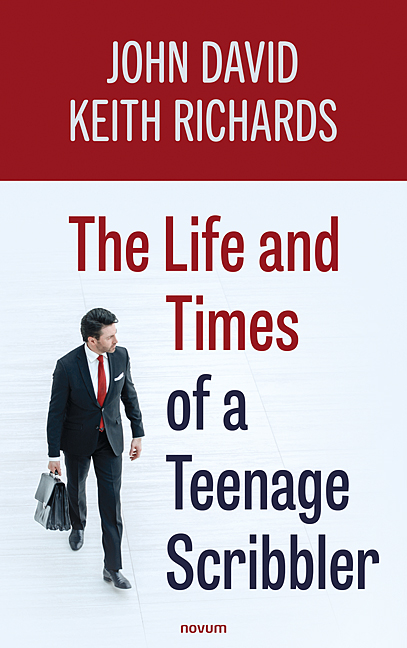
The Life and Times of a Teenage Scribbler
GBP 27,90
Format: 13,5 x 21.5 cm
Number of Pages: 396
ISBN: 978-3-99130-316-9
Release Date: 20.09.2024
In this quirky and insightful autobiography, John Richards lifts the lid on the world of retail and finance, with a combination of humorous anecdotes and surprisingly accessible explanations of the esoteric workings of life in the ‘City’.
CHAPTER ONE
TIME TRAVEL
It is 1967. Think the game-changing Beatles ‘Sergeant Pepper’ album, psychedelia, the Summer of Love, and imagine my excitement at moving to London and starting my first job. Think again! I was starting work in the City, where pin-striped dinosaurs still ruled. You could still see them every morning among the multitude swarming across London Bridge, the bowler hats and furled umbrellas marking them out. It could be 1867 not 1967, the singular difference being that in 1967 a substantial proportion of the commuters were female. ‘Essex girls’ saw the City as a magnet, a short, convenient commute into Liverpool Street or Fenchurch Street stations, which opened the doors to a different world. The Holy Grail was a job as a telephonist, typist or better still a secretary in a stockbroking firm.
I should have known better. In the spring of 1967, I had done the ‘milk round’ of uninspiring job interviews while in my final year at Birmingham University. I was highly qualified to do nothing, although not as highly qualified as I should have been, having in my second year discovered bridge and spending weekends and evenings playing endless hands of cards. This had not, of course, been my fault or design. One evening I was sat in the faculty common room before going home and was seduced by three guys desperate for a four to play bridge. I protested my ‘virginity’ but learnt to play that evening through bitter experience and grew to love it.
My degree had involved a mix of economics, politics and sociology and a smattering of psychology, which only convinced me that I was ‘mad’, and I had a vague idea about wanting a job in marketing. My mother had insisted that I should do accounting because there would be a job at the end of it. However, at the end of my first year I switched courses. Accounting was dull, but what finished it for me was my friend, Phil, who patently did very little work. As I emerged from the examination room, bruised and fearful of the outcome, I bumped into a smiling, ebullient Phil. ‘That was easy,’ he said.
‘You have got to be joking!’
‘No,’ he said, ‘accounting is easy, because if you don’t know what to do, just do the opposite to what seems sensible. It works every time!’
That finished accounting for me, but I was yet to discover that the ‘dismal science’ was also fatally flawed. In many ways my switch from accounting to economics was akin to jumping out of the frying pan into the fire. I had already harboured doubts about economics, since its theories were often based upon totally unrealistic assumptions such as there being no transport costs in international trade theory. The fatal flaw is that it is a social science which has to rely upon the fatuous assumption that people behave rationally, whereas the natural sciences can rely on immutable facts such as how molecules or particles will behave. In order to achieve greater influence and respect economists harnessed the power of numbers, calling it econometrics, and presenting themselves as pseudo-pure scientists. The tyranny of numbers has lent a credibility and certainty to economists’ forecasts, which is totally unjustified. I would hold economists as guilty as the bankers in the 2008 financial crash and our seemingly ongoing economic malaise. Economics can never be a pure science which provides the politicians with accurate guidance. If I were to reproduce the answers that I gave in my 1967 final degree examination today I would fail!
As I increasingly discovered in my life, the main determinant of my path and subsequent success has been a series of unplanned accidents and coincidences. To this day, I invariably distrust and pity anyone who tells me they knew from childhood exactly what they wanted to do when they grew up. I think this irrational prejudice was fuelled by the question I always feared from kindly aunts, who would beam at me and say, ‘What do you want to be when you grow up?’ Once I’d passed the stage of ‘engine driver’ being acceptable, I felt increasingly embarrassed and worried that there must be something wrong with me, because I didn’t have a clue as to what I could actually do. If I’m totally honest, I did fantasise about two activities: being the manager of a pop group (sadly none of my friends had any musical talent) or a film director. I was afraid people would mock these choices and, in any event, I had no idea how I could prepare for or make either of these pipe dreams a reality.
Fortuitously, my generation never needed to worry about getting a job. We were always spoilt for choice. In her book, Snakes And Ladders The Great British Social Mobility Myth, Selina Todd labelled children born between the mid-1930s and the mid-1950s as ‘the Golden Generation’. We were more likely to be upwardly mobile than any generation before or since. If you were a man, over fifty per cent (for women, forty per cent) reached a higher social class than their parents. The UK’s post-war economy created an abundance of ‘white collar’ jobs in the public and service sectors, and no unusual ability, hard work or overriding ambition was required to find a secure job. You fell into work, and the real challenge for many of us was to try and avoid work for as long as possible, always secure in the knowledge that there would be a job waiting the moment it was wanted. We enjoyed an exceptional ascent towards opportunity and prosperity, which for a time looked like the way life would always be. The Golden Age applied to the world of work but not to social attitudes (there was a time lag) and certainly not to educational opportunities. In the early 1960s, no more than three or four per cent of school leavers went on to university, while the Eleven Plus exams had labelled millions of children as failures at eleven years of age.
Had anyone ever said to me that I would work in the City, I would have looked at them in amazement and probably retorted with a string of four-letter words. There was though a strange portent. On a school trip to Stratford to see Henry V, while we were waiting for the train, I suddenly had the idea of buying the Financial Times. I sat on the train with my paper, looking at share prices, pretending to my friends to be a city gent. Another pointer to my future destiny, which I did not consciously recognise at the time, was my prolific letter writing. Our local ‘rag’, The South Wales Echo, included a four-page ‘Pop Special’ every Saturday, which was devoted to pop music, trivia and gossip. It included a letters page, ‘Teenage Post’, and a few of my friends and I competed with each other to see how many of our letters we could get published. It was no contest; I won easily with around fifteen letters appearing over the period from the summer of 1962 to the autumn of 1963. My nearest rival, J A (Tony) Davies, managed to score only five, while Jeffrey Fifer and Peter Harwood managed only one each. Other contributors included Sandra Westlake, my girl- friend and first wife, and Janet Burden, my first ‘real’ girlfriend. She wrote a letter in response to a letter that I had written about ‘sad songs’, saying, ‘After reading J Richards’ letter in last week’s “Pop Special”, it appeared to me that he could never have experienced the tragedy of a broken love affair, or he would never dislike sad songs.’ I was not amused, as some time before, Janet had ‘dumped’ me and was now going out with one of my friends. Even more annoying was a subsequent letter written jointly by Janet and my ‘friend’ Dave Bale! More aggravation was to follow in June 1962 when a letter from a Miss Heyman, an unknown female, appeared. It said that after reading my letter in last week’s
‘Teenage Post’, she thought that it showed one of the biggest failings in today’s youth – its narrowmindedness. I was driven to write the following riposte.
Ignorant?
I was absolutely astounded by Miss Heyman’s letter in last week’s ‘Teenage Post’. Does she have the audacity to say that anyone who writes about ‘pop’ music is ignorant, uneducated and uninterested in politics?
‘Teenage Post’ is, in my opinion, primarily intended for letters about ‘pop’ music. I suggest to Miss Heyman that she reads the South Wales Echo Postbag if she wants to read letters about politics.
J D K Richards, Windermere Avenue,
Roath Park, Cardiff, South Wales Echo,
Saturday 30th June 1962
I enjoyed writing and found it easy to adapt my style and subject matter to the target audience. And contrary to the previous letter, I did write about serious issues such as reducing the voting age from twenty-one. I enjoyed the public profile and was incentivised by the competition and the fact that ‘starred’ letters – and six of mine were – won a fifteen-shilling record voucher, enough to buy two singles in those days.
My job interviews with illustrious giants of British industry proved depressing and uninspiring, and the thought of spending my working life with these narrowminded, unimaginative, conservative and complacent management hierarchies seemed like purgatory. I had arranged a job interview with United Biscuits in West London and, merely in order to double up on expenses and make a profit on the day, I also arranged an interview with the mighty Prudential Assurance (the ‘Pru’) on the same day. I had no interest in this job and hadn’t even bothered to find out anything about it. Surfacing from the underground at Chancery Lane, I gazed across the road at the red brick Gothic monstrosity (no doubt loved by John Betjeman!) that was the Pru’s head office. I wondered if I’d come to the right place, half-expecting to see monks emerging from this august monument. It was the right place and, as I announced myself in the impressive entrance hall-cum-reception area, discovered to my relief that I was expected. In due course I was ushered along, up and down a maze of corridors, and such was the configuration of this old building, which had been partially modernised to create offices, that I had a panic wondering how I’d ever find my way out of this rabbit warren.
Reaching the end of this tortuous journey, I found myself in a small office being greeted by Ron Artus, whom I later came to admire and recognise as a City luminary and innovator, who pioneered two important developments – the use of research as an investment tool and the consequent employment of investment analysts and the duty which institutional investors should exercise on behalf of shareholders to ‘police’ and enhance management performance. At this point I didn’t even realise that the job I was being interviewed for was anything connected to the City. The interview went surprisingly well, and I had no hesitation in immediately accepting the subsequent job offer. It was a ‘no-brainer’. For reasons I didn’t fully understand and didn’t question, they were offering more money than anyone else. Also, I was to work in what was called the Economic Intelligence Department, which sounded more like academia than business. It would be a comfortable half-way house between university and the real world and would give me the breathing space to discover what I really wanted to do. Little did I know what a momentous step I had taken into the unknown.
My starting salary in the Autumn of 1967 was the princely sum of nine hundred and twenty-four pounds per annum including the London allowance (equivalent to around seventeen thousand pounds today). At university, my best friend, Roger Latham, always said that his ambition in life was to earn one thousand pounds a year and own a Jaguar car, the supreme status symbol of the West Midlands and therefore entirely appropriate for a Wolverhampton boy like Roger. Well, I was almost halfway there. A number of my other university friends were unhappy with my career choice. They immediately recognised what I did not – that I had joined the City. They accused me of ‘selling out’, and I never saw or heard from most of them again. I guess they had the wrong impression of me. I was a natural rebel (most of my friends would say cynic), left-leaning and attended meetings of the university’s Communist Society. However, my attraction to Communism was to listen to the romantic idealism of much older party members who painted a picture of a paradise not dissimilar to the Christian one. It bore no relationship to reality, Russia or current politics.
I was, however, to see several of my old fellow students again when, in 1977, I received an invite to attend a Commerce and Social Science Re-union in Birmingham, ten years after we had all graduated. Initially, I wasn’t convinced this was something I wanted to do, but curiosity got the better of me. It was a weird experience. Some people I didn’t even recognise, including one seemingly dissolute, scruffy, anarchic student who had transformed himself into a pillar of the establishment and was a local Tory councillor. Yet, there were others I could chat away to as if it had only been yesterday that we had last seen each other. A common theme was that almost all the students who had chosen to become accountants were feeling frustrated with their lack of progress and increasingly mundane, unfulfilling roles. While nobody specifically talked numbers it was readily apparent that I was earning more money than anyone else in my year, not an outcome that seemed remotely likely in 1967. While personally very satisfying, I recognised that this imbalance was an indictment of the UK economic structure and, in particular, the low status of industry and any social work. It was as if little had changed since the eighteenth century, when the favoured career choices were politics, the army, serving in our overseas possessions, the church or running your country estate. Anything except ‘getting your hands dirty’ in industry, which was not considered proper for a ‘gentleman’, and it was left to non-conformists and immigrants who were either barred from the professions or lacked a family inheritance.
FIRST IMPRESSIONS
My City career began in mid-September 1967. The Economic Intelligence Department was a retreat from the bustle and noise of High Holborn. It looked out onto Leather Lane, which at that time was a narrow, dark passage between the Pru and the Gamages department store and was laid out like a library. The only differences were the partitions separating the three groups of desks and, in the middle, the ‘box’, which was built to shield the head of the department from the rest of us. The more senior you got to be the more you were isolated from the ‘workers’. This took several stages. Initially, there was a dark-wood box with a window and one end open to the department, then a completely enclosed separate office along the corridor and, finally, an office on a different upper floor. This segregated hierarchy was further reinforced by managers’ also ‘enjoying’ separate toilet facilities and a separate canteen. The formal, one might say fossilised, management structure at the Pru was the norm in the 1960s. Harold Wilson’s ‘white heat of technology’ had, as yet, to impinge upon office life or begin to change entrenched attitudes to work practices. This was highlighted at Christmas, when we were all instructed to line up to be presented to the chief executive. This tradition was meticulously modelled on a royal visit, with the chief shaking hands with each of us and pausing to exchange a few words with a selected few. This was pre-arranged, and exchanges were of the ‘I hear you were a rugby blue’ type and never about work. At our department’s celebratory Christmas dinner, I shocked everyone by turning up wearing my blue crushed-velvet jacket from Take Six in Carnaby Street. But my real ‘crime’ was not wearing a tie!
We were a motley crew, predominantly Oxbridge and male of course, but nevertheless an interesting variety of colourful characters with several exceptions to the rule. There was Mick Newmarch, who went on to become the chief executive of the Prudential Corporation on the 1st April 1990. Mick had joined the department straight from school (a North London grammar school) in 1955 and had been employed as a statistical assistant, essentially a general ‘dogsbody’, primarily tasked with plotting and drawing up share price graphs. He took an external economics degree and by the late sixties was deemed qualified to be an investment analyst. He was an outstanding bridge player, county standard and way beyond my league. His ambition was very visible and highlighted by the annual senior managers’ Christmas dinner, at which junior staff were ‘privileged’ to wait at table. Mick volunteered to be a waiter every year and encouraged others to join him, saying, ‘It’s a great opportunity to get your face known by senior management.’ Naturally, this was an opportunity that I felt as a matter of principle was demeaning. And on a more practical level, I felt it could ruin my promotion prospects since it was highly probable that I would end up spilling the soup over someone!
Then, there was Stewart Fleming who, on the face of it, was just another traditional rugby-playing Oxbridge product but proved to be a great and interesting friend. Stewart went on to be a journalist, working primarily for the Guardian and the Financial Times. At one stage, he was the FT’s Washington correspondent and enjoyed a one-to-one with President Reagan, who Stewart said proved to be surprisingly knowledgeable and erudite. His interview related primarily to the treaties and talks with the Russians regarding the controls over nuclear weapons, hardly the simplest and most straightforward of topics. I always found it ironic that Stewart for the most part was an economics correspondent, having never studied economics and not trusting banks. While at the Pru, he insisted on collecting his monthly salary in cash from the cashier’s office rather than having it paid directly into a bank account like everyone else. Well, perhaps in the light of the 2008 financial meltdown, Stewart was remarkably prescient and knew something that nobody else even suspected! Sadly, Stewart was one of the first recognised cases of RSI and was forced into a premature early retirement.
My immediate boss, Brian Edwards, was notable for being risk averse and even had an insurance policy to cover him in case he hurt anyone with his umbrella. We used to joke that when he received his monthly salary cheque, he actually owed the Pru money after they had deducted all his insurance payments. I should explain that there was an incentive to take out insurance with the Pru since, as employees, we would count as an agent for the policy and receive a commission.
I was not the sole redbrick university product in the office. The year before I arrived, the first ever non-Oxbridge graduate had been recruited. Graham Poulton retained his northern accent but otherwise appeared to conform to the accepted mould. I always regarded Graham and myself as being something of a social experiment, but all credit to Ron Artus for taking what was a bold and revolutionary step in graduate recruitment at that time.
THE WORK
As the department’s name suggested, the work was research. There was no formal on-the-job training, a situation that was common to all City institutions. You were thrown in at the deep end and either sank or swam. I remember hearing my new colleagues constantly referring to P.E.s. I couldn’t work out what on earth this might be beyond being something to do with the valuation of shares. Not wishing to display my ignorance, I visited the local library one lunchtime and found the equivalent of a ‘teach yourself investment’ book and began to teach myself investment analysis. The mystery of the P.E. was simply the ratio between a share price and a company’s profits. The role of the investment analyst is essentially to identify value for shareholders. The actual work involves understanding, forecasting and commenting with authority on all the factors affecting an industry and its major companies. This must be put into numbers in order to make it respectable and acceptable. Thus, the knowledge would be converted into estimates of company profits expressed in terms of earnings per share (EPS), dividends per share (DPS), and return on capital. These would then be compared with the rest of the stock market in terms of ratios such as the P/E and earnings before interest, tax and depreciation (EBITDA). This would tell you whether a company’s shares were under- or over- valued and, on this basis, you would make your recommendation – the sensitive part of the process since it impinged directly upon management’s egos and pride. My glossary of City terminology can be found as an appendix at the end of the book.
TIME TRAVEL
It is 1967. Think the game-changing Beatles ‘Sergeant Pepper’ album, psychedelia, the Summer of Love, and imagine my excitement at moving to London and starting my first job. Think again! I was starting work in the City, where pin-striped dinosaurs still ruled. You could still see them every morning among the multitude swarming across London Bridge, the bowler hats and furled umbrellas marking them out. It could be 1867 not 1967, the singular difference being that in 1967 a substantial proportion of the commuters were female. ‘Essex girls’ saw the City as a magnet, a short, convenient commute into Liverpool Street or Fenchurch Street stations, which opened the doors to a different world. The Holy Grail was a job as a telephonist, typist or better still a secretary in a stockbroking firm.
I should have known better. In the spring of 1967, I had done the ‘milk round’ of uninspiring job interviews while in my final year at Birmingham University. I was highly qualified to do nothing, although not as highly qualified as I should have been, having in my second year discovered bridge and spending weekends and evenings playing endless hands of cards. This had not, of course, been my fault or design. One evening I was sat in the faculty common room before going home and was seduced by three guys desperate for a four to play bridge. I protested my ‘virginity’ but learnt to play that evening through bitter experience and grew to love it.
My degree had involved a mix of economics, politics and sociology and a smattering of psychology, which only convinced me that I was ‘mad’, and I had a vague idea about wanting a job in marketing. My mother had insisted that I should do accounting because there would be a job at the end of it. However, at the end of my first year I switched courses. Accounting was dull, but what finished it for me was my friend, Phil, who patently did very little work. As I emerged from the examination room, bruised and fearful of the outcome, I bumped into a smiling, ebullient Phil. ‘That was easy,’ he said.
‘You have got to be joking!’
‘No,’ he said, ‘accounting is easy, because if you don’t know what to do, just do the opposite to what seems sensible. It works every time!’
That finished accounting for me, but I was yet to discover that the ‘dismal science’ was also fatally flawed. In many ways my switch from accounting to economics was akin to jumping out of the frying pan into the fire. I had already harboured doubts about economics, since its theories were often based upon totally unrealistic assumptions such as there being no transport costs in international trade theory. The fatal flaw is that it is a social science which has to rely upon the fatuous assumption that people behave rationally, whereas the natural sciences can rely on immutable facts such as how molecules or particles will behave. In order to achieve greater influence and respect economists harnessed the power of numbers, calling it econometrics, and presenting themselves as pseudo-pure scientists. The tyranny of numbers has lent a credibility and certainty to economists’ forecasts, which is totally unjustified. I would hold economists as guilty as the bankers in the 2008 financial crash and our seemingly ongoing economic malaise. Economics can never be a pure science which provides the politicians with accurate guidance. If I were to reproduce the answers that I gave in my 1967 final degree examination today I would fail!
As I increasingly discovered in my life, the main determinant of my path and subsequent success has been a series of unplanned accidents and coincidences. To this day, I invariably distrust and pity anyone who tells me they knew from childhood exactly what they wanted to do when they grew up. I think this irrational prejudice was fuelled by the question I always feared from kindly aunts, who would beam at me and say, ‘What do you want to be when you grow up?’ Once I’d passed the stage of ‘engine driver’ being acceptable, I felt increasingly embarrassed and worried that there must be something wrong with me, because I didn’t have a clue as to what I could actually do. If I’m totally honest, I did fantasise about two activities: being the manager of a pop group (sadly none of my friends had any musical talent) or a film director. I was afraid people would mock these choices and, in any event, I had no idea how I could prepare for or make either of these pipe dreams a reality.
Fortuitously, my generation never needed to worry about getting a job. We were always spoilt for choice. In her book, Snakes And Ladders The Great British Social Mobility Myth, Selina Todd labelled children born between the mid-1930s and the mid-1950s as ‘the Golden Generation’. We were more likely to be upwardly mobile than any generation before or since. If you were a man, over fifty per cent (for women, forty per cent) reached a higher social class than their parents. The UK’s post-war economy created an abundance of ‘white collar’ jobs in the public and service sectors, and no unusual ability, hard work or overriding ambition was required to find a secure job. You fell into work, and the real challenge for many of us was to try and avoid work for as long as possible, always secure in the knowledge that there would be a job waiting the moment it was wanted. We enjoyed an exceptional ascent towards opportunity and prosperity, which for a time looked like the way life would always be. The Golden Age applied to the world of work but not to social attitudes (there was a time lag) and certainly not to educational opportunities. In the early 1960s, no more than three or four per cent of school leavers went on to university, while the Eleven Plus exams had labelled millions of children as failures at eleven years of age.
Had anyone ever said to me that I would work in the City, I would have looked at them in amazement and probably retorted with a string of four-letter words. There was though a strange portent. On a school trip to Stratford to see Henry V, while we were waiting for the train, I suddenly had the idea of buying the Financial Times. I sat on the train with my paper, looking at share prices, pretending to my friends to be a city gent. Another pointer to my future destiny, which I did not consciously recognise at the time, was my prolific letter writing. Our local ‘rag’, The South Wales Echo, included a four-page ‘Pop Special’ every Saturday, which was devoted to pop music, trivia and gossip. It included a letters page, ‘Teenage Post’, and a few of my friends and I competed with each other to see how many of our letters we could get published. It was no contest; I won easily with around fifteen letters appearing over the period from the summer of 1962 to the autumn of 1963. My nearest rival, J A (Tony) Davies, managed to score only five, while Jeffrey Fifer and Peter Harwood managed only one each. Other contributors included Sandra Westlake, my girl- friend and first wife, and Janet Burden, my first ‘real’ girlfriend. She wrote a letter in response to a letter that I had written about ‘sad songs’, saying, ‘After reading J Richards’ letter in last week’s “Pop Special”, it appeared to me that he could never have experienced the tragedy of a broken love affair, or he would never dislike sad songs.’ I was not amused, as some time before, Janet had ‘dumped’ me and was now going out with one of my friends. Even more annoying was a subsequent letter written jointly by Janet and my ‘friend’ Dave Bale! More aggravation was to follow in June 1962 when a letter from a Miss Heyman, an unknown female, appeared. It said that after reading my letter in last week’s
‘Teenage Post’, she thought that it showed one of the biggest failings in today’s youth – its narrowmindedness. I was driven to write the following riposte.
Ignorant?
I was absolutely astounded by Miss Heyman’s letter in last week’s ‘Teenage Post’. Does she have the audacity to say that anyone who writes about ‘pop’ music is ignorant, uneducated and uninterested in politics?
‘Teenage Post’ is, in my opinion, primarily intended for letters about ‘pop’ music. I suggest to Miss Heyman that she reads the South Wales Echo Postbag if she wants to read letters about politics.
J D K Richards, Windermere Avenue,
Roath Park, Cardiff, South Wales Echo,
Saturday 30th June 1962
I enjoyed writing and found it easy to adapt my style and subject matter to the target audience. And contrary to the previous letter, I did write about serious issues such as reducing the voting age from twenty-one. I enjoyed the public profile and was incentivised by the competition and the fact that ‘starred’ letters – and six of mine were – won a fifteen-shilling record voucher, enough to buy two singles in those days.
My job interviews with illustrious giants of British industry proved depressing and uninspiring, and the thought of spending my working life with these narrowminded, unimaginative, conservative and complacent management hierarchies seemed like purgatory. I had arranged a job interview with United Biscuits in West London and, merely in order to double up on expenses and make a profit on the day, I also arranged an interview with the mighty Prudential Assurance (the ‘Pru’) on the same day. I had no interest in this job and hadn’t even bothered to find out anything about it. Surfacing from the underground at Chancery Lane, I gazed across the road at the red brick Gothic monstrosity (no doubt loved by John Betjeman!) that was the Pru’s head office. I wondered if I’d come to the right place, half-expecting to see monks emerging from this august monument. It was the right place and, as I announced myself in the impressive entrance hall-cum-reception area, discovered to my relief that I was expected. In due course I was ushered along, up and down a maze of corridors, and such was the configuration of this old building, which had been partially modernised to create offices, that I had a panic wondering how I’d ever find my way out of this rabbit warren.
Reaching the end of this tortuous journey, I found myself in a small office being greeted by Ron Artus, whom I later came to admire and recognise as a City luminary and innovator, who pioneered two important developments – the use of research as an investment tool and the consequent employment of investment analysts and the duty which institutional investors should exercise on behalf of shareholders to ‘police’ and enhance management performance. At this point I didn’t even realise that the job I was being interviewed for was anything connected to the City. The interview went surprisingly well, and I had no hesitation in immediately accepting the subsequent job offer. It was a ‘no-brainer’. For reasons I didn’t fully understand and didn’t question, they were offering more money than anyone else. Also, I was to work in what was called the Economic Intelligence Department, which sounded more like academia than business. It would be a comfortable half-way house between university and the real world and would give me the breathing space to discover what I really wanted to do. Little did I know what a momentous step I had taken into the unknown.
My starting salary in the Autumn of 1967 was the princely sum of nine hundred and twenty-four pounds per annum including the London allowance (equivalent to around seventeen thousand pounds today). At university, my best friend, Roger Latham, always said that his ambition in life was to earn one thousand pounds a year and own a Jaguar car, the supreme status symbol of the West Midlands and therefore entirely appropriate for a Wolverhampton boy like Roger. Well, I was almost halfway there. A number of my other university friends were unhappy with my career choice. They immediately recognised what I did not – that I had joined the City. They accused me of ‘selling out’, and I never saw or heard from most of them again. I guess they had the wrong impression of me. I was a natural rebel (most of my friends would say cynic), left-leaning and attended meetings of the university’s Communist Society. However, my attraction to Communism was to listen to the romantic idealism of much older party members who painted a picture of a paradise not dissimilar to the Christian one. It bore no relationship to reality, Russia or current politics.
I was, however, to see several of my old fellow students again when, in 1977, I received an invite to attend a Commerce and Social Science Re-union in Birmingham, ten years after we had all graduated. Initially, I wasn’t convinced this was something I wanted to do, but curiosity got the better of me. It was a weird experience. Some people I didn’t even recognise, including one seemingly dissolute, scruffy, anarchic student who had transformed himself into a pillar of the establishment and was a local Tory councillor. Yet, there were others I could chat away to as if it had only been yesterday that we had last seen each other. A common theme was that almost all the students who had chosen to become accountants were feeling frustrated with their lack of progress and increasingly mundane, unfulfilling roles. While nobody specifically talked numbers it was readily apparent that I was earning more money than anyone else in my year, not an outcome that seemed remotely likely in 1967. While personally very satisfying, I recognised that this imbalance was an indictment of the UK economic structure and, in particular, the low status of industry and any social work. It was as if little had changed since the eighteenth century, when the favoured career choices were politics, the army, serving in our overseas possessions, the church or running your country estate. Anything except ‘getting your hands dirty’ in industry, which was not considered proper for a ‘gentleman’, and it was left to non-conformists and immigrants who were either barred from the professions or lacked a family inheritance.
FIRST IMPRESSIONS
My City career began in mid-September 1967. The Economic Intelligence Department was a retreat from the bustle and noise of High Holborn. It looked out onto Leather Lane, which at that time was a narrow, dark passage between the Pru and the Gamages department store and was laid out like a library. The only differences were the partitions separating the three groups of desks and, in the middle, the ‘box’, which was built to shield the head of the department from the rest of us. The more senior you got to be the more you were isolated from the ‘workers’. This took several stages. Initially, there was a dark-wood box with a window and one end open to the department, then a completely enclosed separate office along the corridor and, finally, an office on a different upper floor. This segregated hierarchy was further reinforced by managers’ also ‘enjoying’ separate toilet facilities and a separate canteen. The formal, one might say fossilised, management structure at the Pru was the norm in the 1960s. Harold Wilson’s ‘white heat of technology’ had, as yet, to impinge upon office life or begin to change entrenched attitudes to work practices. This was highlighted at Christmas, when we were all instructed to line up to be presented to the chief executive. This tradition was meticulously modelled on a royal visit, with the chief shaking hands with each of us and pausing to exchange a few words with a selected few. This was pre-arranged, and exchanges were of the ‘I hear you were a rugby blue’ type and never about work. At our department’s celebratory Christmas dinner, I shocked everyone by turning up wearing my blue crushed-velvet jacket from Take Six in Carnaby Street. But my real ‘crime’ was not wearing a tie!
We were a motley crew, predominantly Oxbridge and male of course, but nevertheless an interesting variety of colourful characters with several exceptions to the rule. There was Mick Newmarch, who went on to become the chief executive of the Prudential Corporation on the 1st April 1990. Mick had joined the department straight from school (a North London grammar school) in 1955 and had been employed as a statistical assistant, essentially a general ‘dogsbody’, primarily tasked with plotting and drawing up share price graphs. He took an external economics degree and by the late sixties was deemed qualified to be an investment analyst. He was an outstanding bridge player, county standard and way beyond my league. His ambition was very visible and highlighted by the annual senior managers’ Christmas dinner, at which junior staff were ‘privileged’ to wait at table. Mick volunteered to be a waiter every year and encouraged others to join him, saying, ‘It’s a great opportunity to get your face known by senior management.’ Naturally, this was an opportunity that I felt as a matter of principle was demeaning. And on a more practical level, I felt it could ruin my promotion prospects since it was highly probable that I would end up spilling the soup over someone!
Then, there was Stewart Fleming who, on the face of it, was just another traditional rugby-playing Oxbridge product but proved to be a great and interesting friend. Stewart went on to be a journalist, working primarily for the Guardian and the Financial Times. At one stage, he was the FT’s Washington correspondent and enjoyed a one-to-one with President Reagan, who Stewart said proved to be surprisingly knowledgeable and erudite. His interview related primarily to the treaties and talks with the Russians regarding the controls over nuclear weapons, hardly the simplest and most straightforward of topics. I always found it ironic that Stewart for the most part was an economics correspondent, having never studied economics and not trusting banks. While at the Pru, he insisted on collecting his monthly salary in cash from the cashier’s office rather than having it paid directly into a bank account like everyone else. Well, perhaps in the light of the 2008 financial meltdown, Stewart was remarkably prescient and knew something that nobody else even suspected! Sadly, Stewart was one of the first recognised cases of RSI and was forced into a premature early retirement.
My immediate boss, Brian Edwards, was notable for being risk averse and even had an insurance policy to cover him in case he hurt anyone with his umbrella. We used to joke that when he received his monthly salary cheque, he actually owed the Pru money after they had deducted all his insurance payments. I should explain that there was an incentive to take out insurance with the Pru since, as employees, we would count as an agent for the policy and receive a commission.
I was not the sole redbrick university product in the office. The year before I arrived, the first ever non-Oxbridge graduate had been recruited. Graham Poulton retained his northern accent but otherwise appeared to conform to the accepted mould. I always regarded Graham and myself as being something of a social experiment, but all credit to Ron Artus for taking what was a bold and revolutionary step in graduate recruitment at that time.
THE WORK
As the department’s name suggested, the work was research. There was no formal on-the-job training, a situation that was common to all City institutions. You were thrown in at the deep end and either sank or swam. I remember hearing my new colleagues constantly referring to P.E.s. I couldn’t work out what on earth this might be beyond being something to do with the valuation of shares. Not wishing to display my ignorance, I visited the local library one lunchtime and found the equivalent of a ‘teach yourself investment’ book and began to teach myself investment analysis. The mystery of the P.E. was simply the ratio between a share price and a company’s profits. The role of the investment analyst is essentially to identify value for shareholders. The actual work involves understanding, forecasting and commenting with authority on all the factors affecting an industry and its major companies. This must be put into numbers in order to make it respectable and acceptable. Thus, the knowledge would be converted into estimates of company profits expressed in terms of earnings per share (EPS), dividends per share (DPS), and return on capital. These would then be compared with the rest of the stock market in terms of ratios such as the P/E and earnings before interest, tax and depreciation (EBITDA). This would tell you whether a company’s shares were under- or over- valued and, on this basis, you would make your recommendation – the sensitive part of the process since it impinged directly upon management’s egos and pride. My glossary of City terminology can be found as an appendix at the end of the book.
You might like this too :