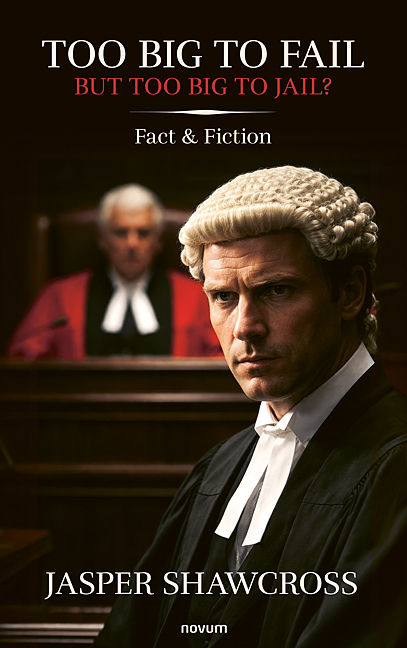
Too Big to Fail – But Too Big to Jail?
Fact & Fiction
GBP 27,90
Format: 13.5 x 21.5 cm
Number of Pages: 462
ISBN: 978-3-99185-167-7
Release Date: 24.09.2026
A top London barrister is drawn into a Hong Kong mega-trial involving global banking crime, political pressure and secret power plays. As the case unfolds, he realizes the verdict could reshape not only his life—but the secret world of money laundering.
CHAPTER ONE
WORKING IN CHAMBERS
Charles Barrington observed the lush green lawns of Gray’s Inn Walks from his desk. He was able to see only an inch or two of the dark green leather of the desk, as it was strewn with papers and briefs with pink ribbons round them. No wonder he was gazing out to the sunlit-blazing lawns through the regency windows of his chambers.
His conference table was also similarly covered with ribboned briefs, some small with twenty or so A4 pages folded across with the loop of pink ribbon holding the papers together. Others, more substantial, these comprising up to 250 pages, were bound cross-ways by the ubiquitous ribbon and tied, as was the tradition at the English Bar, in the center, with an exaggerated bow.
He watched with an envious eye the staff of the companies who were lucky tenants in the buildings within the precinct of Gray’s Inn’s grounds, walking around the luxurious Walks. Gray’s Inn Walks were designed by Sir Francis Bacon in 1608, who was the Treasurer of the Inn. The Walks remain a historic London garden that was once a fashionable retreat for the elite. They remain one of the largest privately owned gardens in London and are still enjoyed by the public today, being open between twelve noon and two-thirty in the afternoon. Barrington watched the staff from these numerous offices enjoying a lunchtime stroll, or having a quiet sandwich lunch sitting on one of the generously provided wooden benches spaced up and down the walks under the avenue of ornamental elm trees providing welcome shade on hot summer days.
Gray’s Inn itself is one of the four exclusive English Inns of Court which developed originally in the thirteenth century, initially as accommodation for practicing barristers. The four inns are Lincoln’s Inn, Middle Temple Inn, Inner Temple Inn, and Gray’s Inn, which is the northernmost Inn of court in the legal area of London. They all enjoy equal status, containing huge law libraries which are used, even today, by senior judges for research purposes.
The historical relevance of the English Bar continues with the colored ribbons which are used by instructing solicitors, who instruct counsel to handle a case in court. Criminal briefs and civil briefs are bound by pink ribbon, prosecution briefs by white ribbon, and occasionally, black ribbon for wills and probate briefs. This practice started in around 1727, and it was originally believed that formal Papal instructions from the Vatican were, at one time, held together by pink ribbon. Hence why Barrington’s desk contained an almost sea of pink ribbon.
He was in the middle of advising a group of rogue company directors who had been charged with fraudulent trading, which is trading a company knowing it was insolvent, for which possible jail time could await them. Observing the pleasant light traffic along the Walks on a hot summer’s day was far preferable to focusing on miscreant company directors.
He remembered how he had been warned by his pupil master when he was a pupil, learning his craft some 15 years earlier, in the very same buildings, that “It’s the thin briefs you have to watch,” he had said with an intake of breath. “They are the ones which ask an apparent simple question. But when you get into it, the work required to answer the ‘simple’ question amounted to hundreds of hours.” Barrington had responded by asking which briefs were the ones to go for in terms of judging them by size. “That’s a good question, Charles, although a little naïve, like judging a book by its cover,” his pupil master had said, as a grin began to appear. “The ones which come in a truckload of ring-bound folders, and where the formal instructions are in a large number of ring-bound folders themselves.” Charles had clearly displayed signs of curiosity at this reply. “That’s because,” his pupil master replied, looking at him directly in the eyes with an amused grin, “those are the ones you make your fuck-you money on,” was his dry but humorless response.
Barrington smiled as he remembered Giles Rorke’s words of wisdom. After fifteen years of dedicated practice he still awaited the treasured “fuck-you money” brief. As did every other greedy bastard in chambers, and they would go to great lengths to ensure they got it. It may be a gentleman’s profession, Barrington mused, but when it came to professional competition, it often got no nastier than at the English Bar, where stabbing fellow members of the profession in the back was the accepted manner of competing with colleagues in certain circumstances.
Fortunately for Charles Barrington, he had succeeded in carving out for himself a niche in a specialized practice of commercial criminal work with also a smaller niche for criminal/commercial cross-over work. He spent most of his time in court where he defended VAT fraudsters, commercial fraudsters, and company directors, usually up for disqualification for some company law infraction, normally profiting personally immediately before the demise of the company they had been busy raping. A lot of it was pretty routine, the bent directors coming in a variety of styles, from former forex dealers who got too cute for their own good, trading and losing spectacularly OPM (other people’s money), to aristocrats with the ingrained and unshakeable belief that their lifestyle of luxurious excess was a natural entitlement and could not bring themselves to believe that they had done anything wrong by using company money as though it was their own.
One of the most significant cases of Barrington’s career to date was a highly publicized case of a former SAS army officer, one Major Jim Bowen, who had, after becoming the youngest major in the SAS, on leaving the regiment, formed a PR company which had become high profile and very successful. As part of the PR company’s services offered to the highly discriminating clientele, there were shooting weekends at an estate in Surrey, where the retired army major’s business partner owned 2,000-odd acres, and this endeavor had started to make a lot of money providing the wealthy with their weekend fun and games. Staying in the small ‘stately’ as part of the package was the real treat for the punters, as the major’s partner laid on the finest call girls for their delectation and enjoyment. It had become so successful–and so discreet–that government ministers had been known to visit, and it was, being so quintessentially English, a big draw for foreign millionaires and even the occasional billionaire.
In the way that the Chicago prosecutors approached Al Capone, when the police began investigating the nevertheless discreet operation, they figured that charges on prostitution would be too difficult to prove, as money never changed hands between the punters and the girls. Jim Bowen had set it up so protection of the punters was paramount, and the girls were paid by his company only for their ‘time’. Instead, the police looked at the company’s books. And there it was. Quarterly entertainment charges booked into the accounts as an expense and allegedly deductible from the company’s gross profits. Essentially, a tax fraud on the Revenue; “that will do!” the prosecution triumphantly declared.
Once interviewed by the boys in blue, the major lost no time in contacting Charles. They had known each other in Northern Ireland where Charles had served most of his three-year short-service commission in the Worcestershire Regiment. Not only had they known each other, they had been on black ops together. They had even killed together–not birds of a feather, you understand, but birds called the IRA.
Charles pulled out all the stops for his old army colleague; no stone was left unturned, and having worked until the small hours for weeks, he discovered in the books of account that the accountants had made errors. They had simply got their arithmetic wrong, not badly, but significantly wrong enough to enable Charles to force the responsible audit partner of the esteemed firm of EPMC to admit in cross-examination that they had made mistakes.
The scene was set.
“And I suppose,” Charles had asked the partner at the crescendo moment of his questioning, who was now shell-shocked and confused after two hours of meticulous cross-examination, “that booking these shooting weekend charges as deductible expenses could have been a mistake also?”
There was a silence in the courtroom as all eyes focused on the response. Charles remembered distinctly the judge leaning forward slightly to observe the exposed witness’s response. “I suppose under the circumstances it could well have been,” came the response Charles had planned four weeks of preparation to achieve.
“Thank you,” he said pleasantly to the shell-shocked witness. “Thank you, my Lord, no further questions.”
Charles had done such a complete demolition job in cross-examination that not even prosecuting counsel’s re-examination could rescue the situation. Charles had the case withdrawn from the jury at the close of the prosecution case, and it became a signal victory lauded in the newspapers the next day as “Victory for the Galloping Major”. Charles had become an overnight high-profile barrister and celebrity and his name was mentioned in the tabloid, The Sun, five times.
Major Bowen came round to visit Charles shortly after the heroic victory. He explained to him with a grin that he had stopped the stately “entertainment” at the shoot, and as a result business was not as brisk, but that he was so deeply grateful to him for his brilliant work he would make it up to him one day.
“I am quite serious, Charles,” he had said, looking at him directly. “There’s a lot you don’t know about what I do, and this goes no further than these four walls.”
Charles, shaking his head, responded, “Of course, James, you can take that as read,” although he thought it was a strange remark. He remembered being covered in camouflage cream and mud up to their armpits in Northern Ireland waiting for two days in their shallow trench for their targets to appear. It was the final days of the Troubles before the Peace Agreement, but the IRA still had pockets of extremist killers. They were both shivering with cold and damp and were considering calling the op off; the targets were ‘no-show’. But suddenly a car pulled up along the track, 50 yards from where their hide was. No doubt these were the men they wanted. The tip-off was for real. Three scruffily dressed men with stubble exited the car, looking around suspiciously, awaiting the ‘meet’ to come into view. On James’ command, Charles took out the left-hand side, James took out the right-hand side, and by the time they had fallen, the guy in the middle had hardly time to move. They both finished him together with chest shots, afterwards plugging the other two guys on the ground with pistols to make sure. It was always a nasty business.
As James Bowen left his room, they parted with the firm grip handshake that only army officers truly understand, eyes locked on each other’s. Charles knew he meant it.
What Charles Barrington did not appreciate was how this strange promise and undertaking was about to fundamentally change his life for the far, far foreseeable future.
CHAPTER TWO
AMAZING NEWS
Barrington continued to survey the verdant greens of the Inn, with the occasionally placed sprinkler jetting water to keep the grass in such good condition. He could almost feel the silver cold water. And in Central London too, he thought. Where else could you find such an expanse of lush greenery in such perfect condition?
He stared through the window at the light traffic of people negotiating the gravel pathways in between the lawns, many of them the employees of the commercial tenants who were lucky enough to inhabit offices in such a prime location, and occasionally a barrister or two. Lincoln’s Inn maintained the unique tradition that barristers could walk to courts in their wigs and gowns, whereas other practitioners from the other three Inns of Court were obliged to get changed at court in the robing rooms, so he could see barristers on their way to court carrying their robes in the traditional blue or red bag hauled over their shoulder.
His comfortable daydream was sharply interrupted by a knock at the door. The door opened and in walked Ronald, the senior clerk to chambers.
Ronald had been a barrister’s clerk all his life as had his father before him. The story was his father’s uncle had also been a clerk in the Inn and introduced his nephew to the profession in order to keep him on the straight and narrow, off the racecourse, and out of the pubs. It worked.
Barristers’ clerks earned more than the barristers they worked for. They were paid 10 % of each barrister’s gross earnings, which if you totted up the 35 members of chambers from the most junior to most senior, it would average out to a chambers’ annual income of approximately 20 million pounds. Ten per cent of that? Very nice, thank you, sir.
At the same time, the clerk could make or break a barrister. If he took a dislike to a certain barrister, he would ensure the best briefs which were sent to chambers were pushed away from that person. The flip-side meant that the clerk could make a barrister’s career. The Head of Chambers had been in such a position as he owned a box at Ascot Races, and, mysteriously, each year the Head Clerk would find himself and his mates ensconced in the box at Royal Ascot. Jeremy Walker KC had been incredibly successful–as people would say–“as soon as he bought that bloody box at Ascot”. The inevitable jealousies.
Walker was undoubtedly a talented practitioner and was able to master a brief faster than anyone Charles had experienced. However, his delivery was a little plodding and he rarely set the jury alight. Yet he appeared in a string of high-profile armed robbery cases which were held back-to-back over a two-year period, as they were all related. All the robbers were convicted despite the best attempts by the defense counsel, but this cemented Walker into a position as a ‘heavyweight’ silk or King’s Counsel. Since the senior clerk pushed these lucrative briefs Walker’s way, he had never looked back and was now in heavy demand for top criminal work.
Walker was a brusque individual when it came to personal dealings and never liked to spend more time than was necessary with any individual in case he was obliged to relate to them. Interpersonal relationships were not one of his fortes, and those who didn’t know him well often interpreted his demeanor as arrogance and conceit. In reality he was quite a generous man and hosted the annual chambers party from his own pocket–that was quite a lot of champagne. Standing six feet, he was slim, but with his age approaching fifty-five, he had developed the inevitable paunch, which a good life watching horseracing at Ascot, and a taste for fine wine, had provided for him. At least at fifty-five he had kept most of his dark hair, although very thin on top–a lifetime of wearing a barrister’s wig, Charles concluded.
Ronald came into the room and made an extraordinary request. “Mr. Barrington, may I sit down, please?” he asked in such an earnest manner that Charles knew something big was up.
“Of course, Ronald,” he replied in an enthusiastic manner aimed at putting Ronald at ease. Ronald sat down in front of Charles’ desk.
“Mr. Barrin’ton, I’ve got some good news for you,” he said, looking above Charles’ head as if trying to find somewhere else to focus his eyes.
“Well, I don’t know whether you have heard, but there has been this huge bank fraud in Hong Kong. Something to do with the big bank there, HSBCCI. It’s huge and it involves money laundering and sanction busting, and they are prosecuting the Chairman, CEO, and directors.’
Charles could feel his heart starting to pound; this was work coming his way, he could smell it.
“Go on, Ronald,” he said quietly, trying to calm Ronald down.
“Well, it’s a monster case and there has been a lot of talk about who would take the Junior Brief for the Prosecution. A number of names have been canvassed, all the best, all of them far senior to you, and all of them up for it big time, you know?”
Ronald was now warming to his theme.
“The ‘ fing is about this case is that it’s the ’Ong Kong Government and their Prosecutions Department who make the decisions on who gets briefed, and they haven’t even decided on the Prosecution Leader and which KC that’s going to be.”
Ronald moved position in his seat as he became more comfortable as the story unfolded.
“The ’Ong Kong Government has insisted you are the Junior Counsel to the Prosecution. That’s what I came to tell you.”
Charles was slightly dumbstruck.
“Are you serious?” he exclaimed, with the immediate realization that this was his “fuck-you” money brief.
“Yeah, of course …” said Ronald. “But …” he continued, “the other reason I wanted to see you is because Walker is coming in to see you about it as it is completely contrary to chambers policy as all briefs must come through the clerks’ room, and the clerk normally allocates the work, but here you have been personally chosen.”
Ronald stood up, almost embarrassed as he came out with the conclusion of this newsflash.
“There’s a lot of people going to ’ave their noses outta joint over this, Mr. Barrin’ton, sir, as you don’t ’ave the seniority for it. Not sayin’ you’re not up to it, you definitely are, but there’s a lot of senior juniors out there who would kill for this brief. It’s a six-month-long case in ’Ong Kong, and backed by the HK Government, so the fees will be monstah.”
Monstah had become chambers slang for anything fantastic, and thanks to Ronald’s cockney accent monster had become transformed and utilized by almost all members of chambers.
“Are you going to that party tonight?”
…
You might like this too :