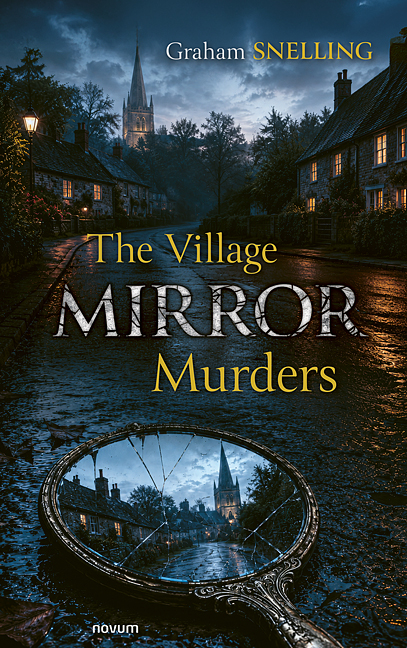
The Village Mirror Murders
GBP 17,90
Format: 13.5 x 21.5 cm
Number of Pages: 156
ISBN: 978-3-7116-1440-7
Release Date: 01.10.2026
A quiet Sussex village is shattered when a young woman is found murdered. As rumours spread and secrets surface, it becomes clear that beneath familiar faces lie hidden lives, dangerous obsessions and a truth no one wants reflected back at them.
Chapter 1
It was twelve noon as Laurie Maine unlocked the door of the Old Railway public house, just as she had done for the past five years; the slow creaking of the door letting in a cool draught from the early spring day. What would today hold for her, she thought, most probably exactly the same as yesterday. Oh, yesterday, Monday 12 March, was possibly the worst day’s takings since she had taken on the pub. Had she realised the recession was around the corner, she would never have made that fateful decision of fulfilling her ambition of becoming a landlady of her own public house, nevertheless she was determined to make a go of it, and she knew there would be good and bad days.
You could put your mortgage on who would walk through the door first; yes it was Harry, a retired widower from the North East. Harry had lived in and around Henfield for about ten years, his second wife Pat died three years ago, and although he always put on a smile and a brave face, one could always see beneath his persona a sadness that only disappeared after a couple of Brown Ales and a large vodka. Poor Laurie, who had turned forty-two this year, always had a jolly, if not sometimes wicked banter with Harry and this continued when the next lunchtime regular entered the pub. Here he comes, old misery guts, Jim Sayers. If you asked Jim how he was, he would look you straight in the eye with the glummest of expressions on his face, and the reply would be, ‘What the bleeding hell has it got to do with you?’ Everyone knew he was joking, but he’d keep up the façade for ages, then finally his ruddy complexion turned into the largest grin, and then a howl of laughter would echo across the bar. Although he gave the impression of being a miserable devil and his language was generally extremely blue, under this showmanship he had a heart of gold and would do anything to help people out; well, almost anyone, as there were certain locals who couldn’t or wouldn’t understand Jim’s manners and ways.
Harry and Jim always sat on the same bar stools in the corner under a picture of Waldorf and Statler from The Muppet Show and the chalk board marked The Grumpy Old Men, how Laurie put up with them every lunchtime and some evenings heaven knows but she loved the rapport, not so much the swearing but they both did a lot to help her out with odd jobs, fetching her food from the markets and so on. For all their moans and groans, she would certainly miss them if they moved on.
The pub was never very busy during the winter as it was situated about half a mile from the High Street of Henfield, a quintessential village nestling under the north side of the South Downs in West Sussex. It would take about ten minutes to walk to the pub from the shops, so most people who enjoyed a lunchtime or early evening drink tended to use one of the three public houses in the High Street; but come the summertime the Old Railway could be heaving with customers who enjoyed walking or cycling along the Downs link. And it was a joyful sight for the hikers and bikers with thirsts to quench on a hot summer day; Laurie had to see out the gloomy winter months, and thanks to regulars such as Harry and Jim and other locals she somehow survived.
Chapter 2
It was early March; the evenings were drawing out and one could feel spring was on its way. Shoppers were out in the High Street, stopping every now and then to chat with friends and passers-by. In a village like Henfield you couldn’t go far without seeing someone you knew, and of course local gossip was rife, most of it friendly humorous banter, but every now and then you had the malicious rumour that unfortunately spread through the village like a bush fire, most of it untrue, but that’s the price of living in a small community. Henfield, though, like many villages was about to become the victim of the property developers in the race to buy up land and make huge profits from the government’s house building plans; some say a good thing for younger people to get on the property ladder, others that smaller places like Henfield does not have the infrastructure to cope with the influx of new residents. The already crowded school and medical centre will have to make expensive plans to accommodate the possible future population increase, and where is the money coming from? Who knows.
The High Street is still busy, but with online shopping and the Tesco and M&S just seven miles away at Shoreham, many shopkeepers are concerned about the future. Banks are closing; there are now five coffee shops and four estate agents, but the small businesses are struggling. Some say the new housing will revive the High Street, but only time will tell. Every community has its characters and odd bods, and Henfield is no exception.
Outside the Old Railway on hot summer days, one could see Tyler Harris sitting in his shorts and T-shirt showing off his multiple displays of tattoos from noon until about four in the afternoon. During that time he would consume about six pints of lager and just sit watching the world go by, and then cycle home. Apparently, Tyler arrived in the village with a travelling circus about ten years ago and just stayed on. Where he works, lives or gets his beer money from, nobody knows. The other characters are Father Dominic Styles and Barry King; both had a past reputation of frequenting the company of slightly sinister individuals. In Father Styles’s case, before he retired he was Deacon at a Catholic Church in Brighton and was well known by most of the local villains. He never mentions his involvement with them but is always talking about meetings and associations with characters such as Bugsy the burglar or Fingers Fred, especially after half a dozen whiskeys. Then there is Barry King. He served five years in Lewes prison for fraud.
He is now going straight but doesn’t work, spends a lot of time in the betting shop, going to race meetings and has about six holidays a year. He is a lovely man and would do anything for you, so in his case it seems crime did pay.
Redoaks is a care home situated in the heart of the village and is the largest employer in Henfield. It used to be a retirement home for ex-gardeners but was bought and renovated into thirty rooms for the elderly and infirm by the Barchester Health Care Group in 1985. Within the beautiful grounds and gardens,
there are twenty assisted living apartments, and this is where our story begins.
Chapter 3
At 11.55 a.m. Jim Sayers was on his way to the Old Railway after walking into One Stop to pick up his morning paper. He always strolled through the Redoaks gardens before meeting up with Harry for their daily pint and chit-chat. As he passed the row of Rhododendron shrubs near Cagefoot Lane, he was startled by a loud rustling behind him in the shrubs. On turning to see, he witnessed a figure running and scurrying at great speed out of the grounds and towards the direction of the High Street.
Jim was somewhat startled at the time, but just thought it was some prankster, so he continued on his way to the Old Railway. Whilst downing his first pint of the day, he related his story to Harry and Laurie; Harry asked if Jim had recognised him but he said he only saw the back and didn’t think he knew him. Harry said it was most probably some idiot on drugs, as there was a known group of traffickers in the village, but the police had no evidence to make arrests at this time.
At about 1.15 p.m., the door opened and a young lad in his teens walked in and appeared to be somewhat shaken and worried. He ordered a large whisky, and Laurie asked him for some means of identification before serving him. He then asked if a young lady with blonde hair and about his age had been in the pub that day.
When Laurie replied no, she asked him who she was and what the problem was, as the lad seemed to be very agitated. He replied, ‘She is my girlfriend; we had a row last night and I haven’t seen her since. I have looked and asked everywhere; she doesn’t drive so she can’t have gone far, and her mobile just goes straight to voicemail.’ He said his name was Tom and he lived in Small Dole, a small village two miles south of Henfield. The last he saw of his girlfriend, whose name is Carla, was at around 11.00 p.m. on Friday; when he called round to see her this morning, her mother said she thought she had stayed overnight with a friend as her bed had not been slept in. Naturally, the parents were now somewhat concerned, but Tom told them he would go round to all the people they knew and he would call them as soon as he found her. ‘I’ve been looking and phoning for over four hours now, and nobody has seen or heard from her,’ he said. ‘She is not the type to go off without letting people know, especially her parents. I have just phoned them and there is still no news.’
Laurie said it was way too early to start worrying, and that she was most probably trying to teach him a lesson following their row and would turn up later. Tom turned and hurried out the door and drove off towards the High Street.
Jim’s first words were, ‘I don’t know what the world’s coming to. I wish my wife would disappear for twenty-four hours.’ Then he laughed out loud and his cheeks turned red with excitement.
The Saturday afternoon customers were now coming in. There was Jack Simpson, a tyre dealer who lives down West End Lane; John Mills, a local farmer; and then in came Barry King, who lives just across the road from the Old Railway. The usual conversations took place, ranging from what sort of day they’ve had to what’s happening at the weekend and how the family is. As Barry doesn’t work and he hasn’t got any family, he can’t say much about that, but he loves his horse racing, so when Danny Scott walked in, who is a real racing enthusiast, Barry was in his element. Danny mentioned that he had just seen a police car with flashing blue lights heading down Church Street. They jokingly looked at Barry and said, ‘Are they looking for you again?’ Barry smiled and took another sip of his pint of lager. By now the pub was filling up as Brighton Football Club was playing on Sky TV.
There was always a strong following for Brighton now that they were in the Premiership, and the Old Railway was the only pub in the village that had Sky.
Meanwhile, back at Redoaks care home, a police car pulled into the grounds in response to a call. Martyn Light, the manager, was waiting at the door. ‘You reported an accident, sir?’ asked the constable as he and his fellow officer walked towards the manager.
‘I think it’s more than an accident,’ he replied, ‘come with me.’
They hurried to the far side of the large garden where a group of the staff was standing. On reaching the spot, which was behind the Rhododendrons, the staff stood away to reveal a young woman lying face up with her clothes tattered and torn. The police checked her and revealed that she was dead.
‘Who found the body?’ the officer asked.
‘It was me, officer, I`m the gardener,’ replied a scruffy man dressed in a green shirt and trousers. ‘I was clearing leaves from behind the bushes when I…’ he looked pale and took a large sigh before saying, ‘I found her.’
‘We need backup, SOCO and an ambulance,’ the first officer said.
‘I’m onto it,’ cried his colleague.
Within twenty minutes, Redoaks was a major crime scene. All the staff and residents were being questioned, but no one could identify the victim, and she was not known to be a local.
By now the news of the death was sweeping around the village like wildfire. It doesn’t take long for any event to become known quickly, but a possible murder or suicide, well, that is something special. Up at the Old Railway, the football match had just ended when Jim Sayers entered, huffing and puffing and shouting out to the customers about what had happened at Redoaks. He looked shaken and worried as he recalled his walk through the grounds earlier. ‘That person I saw, he must have had something to do with it; do you think I should tell the police?’ Laurie said he should contact them immediately.
‘But I didn’t see his face; I wouldn’t recognise him, I can`t even remember what he was wearing, but I suppose I had better tell them.’ He contacted the police and told them what he knew. The only useful information was the time he saw the man, which was just before noon, as Jim was on his way to the pub, which opens at twelve o’clock. He then remembered the young lad who was looking for his girlfriend called Carla. His name was Tom and they lived in Small Dole. This piece of information was paramount to the police investigation, and the hunt was now on for Tom.
Chapter 4
The village was now buzzing with the news of the death, and everyone was wondering how she died. It wasn`t long before the police found young Tom Deely in Small Dole. He told them that Carla was still missing, so the police asked him to describe her. The description matched that of the dead girl; her parents, Mr and Mrs Charlton, were informed and asked if they would identify the corpse and to confirm if it was their daughter or not.
On entering the mortuary, the body slab was pulled out and the blanket gently lifted to reveal the face; the parents both stared at the body for about ten seconds and then one of them shouted out, ‘Oh God, it looks like her, but it’s not our Carla.’ They then embraced in tears and were escorted from the room. The police were now totally baffled; Tom Deely described the hair and appearance of his girlfriend as that of the dead woman exactly; so if this was not her, then who was she, and where was Carla?
Deely was contacted by the police again and shown the body in the mortuary. He confirmed that it was not Carla, but he was amazed at the close resemblance to his girlfriend. He was asked to give a full description of Carla. ‘She is about five feet six. Blonde hair, average weight, and newly tattooed eyebrows, which is very fashionable now. Her hair is usually medium length and in a straight bob hanging down, but sometimes gelled back.’
The information was now being passed on to the media; even though she had only been missing for twenty-four hours, the fact that a murder had been committed meant that she had to be found, as there could be some link between the two women because of the remarkable likeness in appearance.
The first enquiries now would be to ascertain who the dead girl was, where she lived, and what she was doing in the grounds of Redoaks care home.
She had no means of identification, no tattoos apart from her eyebrows, no birthmarks, no wristwatch or jewellery and no mobile phone. Her resemblance to the missing Carla was mystifying to the police, so if this was not Carla, who was she?
Heading up the investigation was DCI Paul Andrews and his team from Horsham CID. Andrews was no stranger to Henfield, as not so long after joining the force he became the village bobby. Those were the days when almost every town and village had its own local police station or house. He was married to Judith, with two now grown-up children, and lives in Manning’s Heath just outside of Horsham. He was due to retire in three years and had served nineteen years in the CID. His Detective Sergeant was Ben Stevens initially from the Met, but now working alongside Andrews.
The autopsy revealed she had been stabbed in the right shoulder and once in the heart, but there were no signs of sexual assault, and she had been dead for about twelve hours, putting the time of death at about midnight. No murder weapon was found. Forensics were searching the undergrowth and taking photos and samples of the area in Redoaks where the body was found and would report to Andrews if any useful information came to light.
Andrews’ first action was to arrange a house-to-house enquiry in Henfield to try to establish if the dead woman was known locally and to show a photo of Carla to all residents and businesses. Also, to check footage of all CCTV cameras within the village.
...
It was twelve noon as Laurie Maine unlocked the door of the Old Railway public house, just as she had done for the past five years; the slow creaking of the door letting in a cool draught from the early spring day. What would today hold for her, she thought, most probably exactly the same as yesterday. Oh, yesterday, Monday 12 March, was possibly the worst day’s takings since she had taken on the pub. Had she realised the recession was around the corner, she would never have made that fateful decision of fulfilling her ambition of becoming a landlady of her own public house, nevertheless she was determined to make a go of it, and she knew there would be good and bad days.
You could put your mortgage on who would walk through the door first; yes it was Harry, a retired widower from the North East. Harry had lived in and around Henfield for about ten years, his second wife Pat died three years ago, and although he always put on a smile and a brave face, one could always see beneath his persona a sadness that only disappeared after a couple of Brown Ales and a large vodka. Poor Laurie, who had turned forty-two this year, always had a jolly, if not sometimes wicked banter with Harry and this continued when the next lunchtime regular entered the pub. Here he comes, old misery guts, Jim Sayers. If you asked Jim how he was, he would look you straight in the eye with the glummest of expressions on his face, and the reply would be, ‘What the bleeding hell has it got to do with you?’ Everyone knew he was joking, but he’d keep up the façade for ages, then finally his ruddy complexion turned into the largest grin, and then a howl of laughter would echo across the bar. Although he gave the impression of being a miserable devil and his language was generally extremely blue, under this showmanship he had a heart of gold and would do anything to help people out; well, almost anyone, as there were certain locals who couldn’t or wouldn’t understand Jim’s manners and ways.
Harry and Jim always sat on the same bar stools in the corner under a picture of Waldorf and Statler from The Muppet Show and the chalk board marked The Grumpy Old Men, how Laurie put up with them every lunchtime and some evenings heaven knows but she loved the rapport, not so much the swearing but they both did a lot to help her out with odd jobs, fetching her food from the markets and so on. For all their moans and groans, she would certainly miss them if they moved on.
The pub was never very busy during the winter as it was situated about half a mile from the High Street of Henfield, a quintessential village nestling under the north side of the South Downs in West Sussex. It would take about ten minutes to walk to the pub from the shops, so most people who enjoyed a lunchtime or early evening drink tended to use one of the three public houses in the High Street; but come the summertime the Old Railway could be heaving with customers who enjoyed walking or cycling along the Downs link. And it was a joyful sight for the hikers and bikers with thirsts to quench on a hot summer day; Laurie had to see out the gloomy winter months, and thanks to regulars such as Harry and Jim and other locals she somehow survived.
Chapter 2
It was early March; the evenings were drawing out and one could feel spring was on its way. Shoppers were out in the High Street, stopping every now and then to chat with friends and passers-by. In a village like Henfield you couldn’t go far without seeing someone you knew, and of course local gossip was rife, most of it friendly humorous banter, but every now and then you had the malicious rumour that unfortunately spread through the village like a bush fire, most of it untrue, but that’s the price of living in a small community. Henfield, though, like many villages was about to become the victim of the property developers in the race to buy up land and make huge profits from the government’s house building plans; some say a good thing for younger people to get on the property ladder, others that smaller places like Henfield does not have the infrastructure to cope with the influx of new residents. The already crowded school and medical centre will have to make expensive plans to accommodate the possible future population increase, and where is the money coming from? Who knows.
The High Street is still busy, but with online shopping and the Tesco and M&S just seven miles away at Shoreham, many shopkeepers are concerned about the future. Banks are closing; there are now five coffee shops and four estate agents, but the small businesses are struggling. Some say the new housing will revive the High Street, but only time will tell. Every community has its characters and odd bods, and Henfield is no exception.
Outside the Old Railway on hot summer days, one could see Tyler Harris sitting in his shorts and T-shirt showing off his multiple displays of tattoos from noon until about four in the afternoon. During that time he would consume about six pints of lager and just sit watching the world go by, and then cycle home. Apparently, Tyler arrived in the village with a travelling circus about ten years ago and just stayed on. Where he works, lives or gets his beer money from, nobody knows. The other characters are Father Dominic Styles and Barry King; both had a past reputation of frequenting the company of slightly sinister individuals. In Father Styles’s case, before he retired he was Deacon at a Catholic Church in Brighton and was well known by most of the local villains. He never mentions his involvement with them but is always talking about meetings and associations with characters such as Bugsy the burglar or Fingers Fred, especially after half a dozen whiskeys. Then there is Barry King. He served five years in Lewes prison for fraud.
He is now going straight but doesn’t work, spends a lot of time in the betting shop, going to race meetings and has about six holidays a year. He is a lovely man and would do anything for you, so in his case it seems crime did pay.
Redoaks is a care home situated in the heart of the village and is the largest employer in Henfield. It used to be a retirement home for ex-gardeners but was bought and renovated into thirty rooms for the elderly and infirm by the Barchester Health Care Group in 1985. Within the beautiful grounds and gardens,
there are twenty assisted living apartments, and this is where our story begins.
Chapter 3
At 11.55 a.m. Jim Sayers was on his way to the Old Railway after walking into One Stop to pick up his morning paper. He always strolled through the Redoaks gardens before meeting up with Harry for their daily pint and chit-chat. As he passed the row of Rhododendron shrubs near Cagefoot Lane, he was startled by a loud rustling behind him in the shrubs. On turning to see, he witnessed a figure running and scurrying at great speed out of the grounds and towards the direction of the High Street.
Jim was somewhat startled at the time, but just thought it was some prankster, so he continued on his way to the Old Railway. Whilst downing his first pint of the day, he related his story to Harry and Laurie; Harry asked if Jim had recognised him but he said he only saw the back and didn’t think he knew him. Harry said it was most probably some idiot on drugs, as there was a known group of traffickers in the village, but the police had no evidence to make arrests at this time.
At about 1.15 p.m., the door opened and a young lad in his teens walked in and appeared to be somewhat shaken and worried. He ordered a large whisky, and Laurie asked him for some means of identification before serving him. He then asked if a young lady with blonde hair and about his age had been in the pub that day.
When Laurie replied no, she asked him who she was and what the problem was, as the lad seemed to be very agitated. He replied, ‘She is my girlfriend; we had a row last night and I haven’t seen her since. I have looked and asked everywhere; she doesn’t drive so she can’t have gone far, and her mobile just goes straight to voicemail.’ He said his name was Tom and he lived in Small Dole, a small village two miles south of Henfield. The last he saw of his girlfriend, whose name is Carla, was at around 11.00 p.m. on Friday; when he called round to see her this morning, her mother said she thought she had stayed overnight with a friend as her bed had not been slept in. Naturally, the parents were now somewhat concerned, but Tom told them he would go round to all the people they knew and he would call them as soon as he found her. ‘I’ve been looking and phoning for over four hours now, and nobody has seen or heard from her,’ he said. ‘She is not the type to go off without letting people know, especially her parents. I have just phoned them and there is still no news.’
Laurie said it was way too early to start worrying, and that she was most probably trying to teach him a lesson following their row and would turn up later. Tom turned and hurried out the door and drove off towards the High Street.
Jim’s first words were, ‘I don’t know what the world’s coming to. I wish my wife would disappear for twenty-four hours.’ Then he laughed out loud and his cheeks turned red with excitement.
The Saturday afternoon customers were now coming in. There was Jack Simpson, a tyre dealer who lives down West End Lane; John Mills, a local farmer; and then in came Barry King, who lives just across the road from the Old Railway. The usual conversations took place, ranging from what sort of day they’ve had to what’s happening at the weekend and how the family is. As Barry doesn’t work and he hasn’t got any family, he can’t say much about that, but he loves his horse racing, so when Danny Scott walked in, who is a real racing enthusiast, Barry was in his element. Danny mentioned that he had just seen a police car with flashing blue lights heading down Church Street. They jokingly looked at Barry and said, ‘Are they looking for you again?’ Barry smiled and took another sip of his pint of lager. By now the pub was filling up as Brighton Football Club was playing on Sky TV.
There was always a strong following for Brighton now that they were in the Premiership, and the Old Railway was the only pub in the village that had Sky.
Meanwhile, back at Redoaks care home, a police car pulled into the grounds in response to a call. Martyn Light, the manager, was waiting at the door. ‘You reported an accident, sir?’ asked the constable as he and his fellow officer walked towards the manager.
‘I think it’s more than an accident,’ he replied, ‘come with me.’
They hurried to the far side of the large garden where a group of the staff was standing. On reaching the spot, which was behind the Rhododendrons, the staff stood away to reveal a young woman lying face up with her clothes tattered and torn. The police checked her and revealed that she was dead.
‘Who found the body?’ the officer asked.
‘It was me, officer, I`m the gardener,’ replied a scruffy man dressed in a green shirt and trousers. ‘I was clearing leaves from behind the bushes when I…’ he looked pale and took a large sigh before saying, ‘I found her.’
‘We need backup, SOCO and an ambulance,’ the first officer said.
‘I’m onto it,’ cried his colleague.
Within twenty minutes, Redoaks was a major crime scene. All the staff and residents were being questioned, but no one could identify the victim, and she was not known to be a local.
By now the news of the death was sweeping around the village like wildfire. It doesn’t take long for any event to become known quickly, but a possible murder or suicide, well, that is something special. Up at the Old Railway, the football match had just ended when Jim Sayers entered, huffing and puffing and shouting out to the customers about what had happened at Redoaks. He looked shaken and worried as he recalled his walk through the grounds earlier. ‘That person I saw, he must have had something to do with it; do you think I should tell the police?’ Laurie said he should contact them immediately.
‘But I didn’t see his face; I wouldn’t recognise him, I can`t even remember what he was wearing, but I suppose I had better tell them.’ He contacted the police and told them what he knew. The only useful information was the time he saw the man, which was just before noon, as Jim was on his way to the pub, which opens at twelve o’clock. He then remembered the young lad who was looking for his girlfriend called Carla. His name was Tom and they lived in Small Dole. This piece of information was paramount to the police investigation, and the hunt was now on for Tom.
Chapter 4
The village was now buzzing with the news of the death, and everyone was wondering how she died. It wasn`t long before the police found young Tom Deely in Small Dole. He told them that Carla was still missing, so the police asked him to describe her. The description matched that of the dead girl; her parents, Mr and Mrs Charlton, were informed and asked if they would identify the corpse and to confirm if it was their daughter or not.
On entering the mortuary, the body slab was pulled out and the blanket gently lifted to reveal the face; the parents both stared at the body for about ten seconds and then one of them shouted out, ‘Oh God, it looks like her, but it’s not our Carla.’ They then embraced in tears and were escorted from the room. The police were now totally baffled; Tom Deely described the hair and appearance of his girlfriend as that of the dead woman exactly; so if this was not her, then who was she, and where was Carla?
Deely was contacted by the police again and shown the body in the mortuary. He confirmed that it was not Carla, but he was amazed at the close resemblance to his girlfriend. He was asked to give a full description of Carla. ‘She is about five feet six. Blonde hair, average weight, and newly tattooed eyebrows, which is very fashionable now. Her hair is usually medium length and in a straight bob hanging down, but sometimes gelled back.’
The information was now being passed on to the media; even though she had only been missing for twenty-four hours, the fact that a murder had been committed meant that she had to be found, as there could be some link between the two women because of the remarkable likeness in appearance.
The first enquiries now would be to ascertain who the dead girl was, where she lived, and what she was doing in the grounds of Redoaks care home.
She had no means of identification, no tattoos apart from her eyebrows, no birthmarks, no wristwatch or jewellery and no mobile phone. Her resemblance to the missing Carla was mystifying to the police, so if this was not Carla, who was she?
Heading up the investigation was DCI Paul Andrews and his team from Horsham CID. Andrews was no stranger to Henfield, as not so long after joining the force he became the village bobby. Those were the days when almost every town and village had its own local police station or house. He was married to Judith, with two now grown-up children, and lives in Manning’s Heath just outside of Horsham. He was due to retire in three years and had served nineteen years in the CID. His Detective Sergeant was Ben Stevens initially from the Met, but now working alongside Andrews.
The autopsy revealed she had been stabbed in the right shoulder and once in the heart, but there were no signs of sexual assault, and she had been dead for about twelve hours, putting the time of death at about midnight. No murder weapon was found. Forensics were searching the undergrowth and taking photos and samples of the area in Redoaks where the body was found and would report to Andrews if any useful information came to light.
Andrews’ first action was to arrange a house-to-house enquiry in Henfield to try to establish if the dead woman was known locally and to show a photo of Carla to all residents and businesses. Also, to check footage of all CCTV cameras within the village.
...
You might like this too :