
A More Enlightened Conservationist
GBP 21,90
Format: 13.5 x 21.5 cm
Number of Pages: 306
ISBN: 978-3-7116-0705-8
Release Date: 19.11.2026
Through inspiring stories from the world of conservation, A More Enlightened Conservationist seeks to put a positive spin on and recount practical, workable solutions that move towards tackling many of the world’s current ecological issues.
A few more words from the author.
In a world that seems to cover only terrible news these days, it’s essential, I think, to focus on some more positive stuff too; we’d all fall into suicidal despair if we thought about what was happening out there too much. So, in this book, I’ve decided to lighten up and cover some of the more genuine conservation success stories, putting an altogether rosier glow on things in order to lift the mood that bit, as it were. In my last book I was looking for dirt, but in this one I’ve been searching for those who are truly on the side of the angels. Being very much an old-school conservationist myself, I wanted to cover practical, workable solutions to get a far better understanding of how things should be done in the name of real ecology.
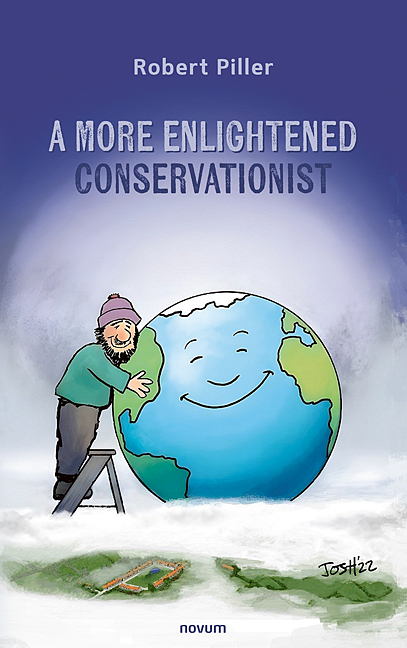
For those of you who read the last one, check out pages 10–12; spot the similarities but note too the differences. The first thing I did was change my personal photo; I don’t look quite so nerdy in this one. I’m not really a nerd, I just don’t want to look like one that’s all. The little figure on the previous front cover had a given amount of history for me, so I decided I’d use him yet again. But he’s learnt many lessons since his first appearance; now an altogether much more ‘enlightened’ character, far removed from that clumsy, masked chancer you met before. Someone this time around who knows exactly how to treat the natural world with the kindness and respect the planet truly deserves.
I wanted to keep as much integrity of the original drawing as I possibly could. The mood it evoked was important to me; there’s actually precious little of it left as it happens. It was really quite tricky having it completely unravelled the way it was; the distinctive haloed sky, the lower half of the figure, the steps, and the outline of the globe itself are about all that remains. Those offensive wind turbines, the cruel incumbencies of shackles and chains, and the undignified plasters and bandages have all been removed. The unseemly floor stains and the trash lain strewn across the deck have since melted into landscape and cloud, although I’d like to think the original essence is still in there somewhere. The whole image is now totally liberated, up there in the heights with the Earth lying back appreciatively with a beaming smile. I think it’s great; it’s only a pity the real world can’t be so easily transformed.
There was a somewhat mixed reaction to my previous book, as I fully expected there would be. It was never meant to be a How to Win Friends and Influence … Influence, yes, that’s surely the purpose of every non-fiction writer, but it was never going to win me many friends, let’s be real. One person who you’d never expect to enjoy a book about conservation said they’d actually found it interesting, while another who quite enthusiastically purchased a copy wasn’t quite so taken by it, you could just tell. It wasn’t like I’d oversold it either; I said at the time there’s something in it to offend everyone. But then again, you’re never going to please everyone. Good writing is as much about being true to yourself as it is standing firm to the cause you believe in, and getting that all-important message across no matter what is also a good thing.
I’d like this too to become my legacy; something I can leave behind long after I’ve departed from this place. It’s a lot less controversial than my last book, largely because this one seeks to approve rather than condemn. Reading through however, just because it’s agreeable doesn’t make it a pushover nor indeed, any less of a read. Incidentally, when writing a book, the best advice I can offer is to stay focused. When writing my last one, I concentrated night and day on that little fella on my front cover. If ever I needed inspiration on how to f**k up the planet, he was my go-to guy; there really was no one better.
Although, humour aside, my real secret is about knowing when in the day to do my creative writing. Everyone’s different of course, and what’s good for me might not suit others, but for me at least, it’s up to an hour or so of me getting myself out of bed each morning. That’s when my brain’s at its freshest and the mind’s in a naturally unwound state, and it is then when the best ideas come and the sentences flow most freely onto the written page. You can do your research and bash out all the basic stuff any old time of day, but for polishing up and producing a half-decent finished script, then that for me’s the time to do it.
50 Ways to Save the Planet. A favourable review
With the front cover completely transformed, we can now move on in the certain knowledge that someone’s on the case who knows exactly what he’s doing. No longer that fumbling amateur hopelessly rummaging his way through matters he clearly knew precious little about, he’s now an inspiration of excellence in his quest to actually save the planet. A master of craft, doing his level best to put his previous wrongs right.
This Earth of ours is indeed an incredibly beautiful and precious biosphere, and if we’re going to save it, we will very much need to get things right. And as we venture through the pages this time around, we’ll see there’s a whole lot of really great work happening out there.
Tiresome old words like sustainability and green, which were always so aggressively rolled out, now fully revised to actually mean something. Retrieved from that enveloping fog of deception dreamt up by some madcap pie-in-the-sky ideology that was literally dragging conservation ever deeper into the mire. Looking at purposeful, honest solutions to shift us away from all those previous horrors, how it was originally intended, and as it was always meant to be.
The real green movement
Working with nature rather than against it. It’s all a stark contrast from those awful lefty ideals; they’re right and everyone else is wrong, misguided at best, downright dangerous at worst. It’s difficult to imagine how things could have been a whole lot worse, frankly. Now well away from that precarious cliff edge, liberated up there upon this cloud where he focuses on the tasks ahead.
Striving for the common good, we now stand firmly together rather than all that bitter infighting we had before, seeking the best possible outcomes for the natural world we’re all surely trying to help. Good intentions can actually pave the road to heaven if those intentions are well-conceived and properly thought through. And it’s precisely these properly thought-through ideals that inevitably hold the key for genuinely saving the planet.
Reality Check – Sustainability
Sustainability in its purest form is a way of life that genuinely causes minimal impact on the natural world whilst at the same time producing what’s needed for our own requirements, which is really the only sensible way forward when you think of it.
Created here is an alter-universe, if you like, where everything in it is done well and all is fine. The projects covered are real enough, but what shouldn’t be forgotten is that the same depressing old activities that caused the problems in the first place are still chipping away as relentlessly as ever. The crackpot eco-traptions, which were always more about wishful thinking than anything else, are as threatening and looming today as they’ve always been. The wildlife charities that assume such authority are still busily making their same old awful choices. These, together with all those other everyday activities, which never did go away, are still out there doing their very worst. What a nightmarish scenario it is, all that’s going on in the world and we have governments, companies and organisations clamouring to be seen to be that much greener than everyone else while obviously caring not a jot for the real threats that are happening everywhere.
Education – Teaching & Nurturing
Here we take a close-up look at what part learning facilities such as schools and books might play in influencing young minds, setting our kids onto the right path, as it were, in becoming tomorrow’s hope for the future. As we look around, we might at times think God help us all, but as we look elsewhere then perhaps things are not so bad. I guess it all depends on where you look and what it is you’re looking at. All any of us can really do is hope and pray.
An interest in conservation and the natural world, of course, begins in those formative years when children are at their most keen to learn, and one of the best ways of getting kids involved is by interacting with them on nature walks. When I was this age at school, I had one of the miserabilist teachers you could ever imagine, but for me, the subject matter more than made up for that. Come to think of it, most of my teachers back then were pretty grumpy, although some were more kindly than others, it had to be said. School life for me though, was always a bit of a challenge; either it was me or perhaps that was just the way of things in those days. On eventually leaving school, a mere oik might I add, barely able to spell and with my maths in disarray, I went on from the funny spelt words of my youth to writing books later in life. So, what a turnaround it’s all been.
But anyway, enough about me. Involving kids with nature in the 1950s, besides walks, was a relatively simple matter of pussy willows and sticky buds in vases, or perhaps pea or bean seeds with damp blotting paper pressed around jam jars for observing root systems develop. Watching buds opening and seeing how things grew on the infant school’s nature table each day was captivating stuff that used to fascinate me. But whatever you learnt at school back then was only enhanced by what you were able to find at weekends or on holidays when you ventured into the countryside, the natural world then being one of beauty and wonderment. It would be hard indeed to muster those same feelings of excitement with that void of emptiness we’re so familiar with today, a bland ordeal indeed, contrasting with the days when you were actually able to see things on a walk. Comparing then to what’s around now, they’re two entirely different dimensions, worlds apart, lost in the space of time.
Environmental studies too have taken on an altogether far more sinister role; these days it’s more about frogmarching ‘em off to the nearest wind farm for their mandatory mind-bending excursion. The modern way consists of literally programming our children into becoming zombified tax-paying citizens, and the only wildlife they’re likely to see is on the telly. What a sad, perverted old world it has become.
But of course, the real lessons in life come to us well after those earlier schooldays have ended, the kind of stuff you invariably have to find out all by yourself. As an adult, you get to know who your true friends are, much as you did back in the schoolyard, only things become somehow different and often more politicised.
For many, being suddenly thrown into the adult world, having that childhood gate slammed firmly shut behind us can feel pretty damn daunting. I think it’s the final realisation of knowing all at once you’re on this different plane and that there’s no going back. But you get through it; you become what you are by interacting and competing along with everyone else. Not that I was ever that competitive back then; too busy muddling my way through life to be doing too much competing.
Some of the more valuable lessons I’ve learnt over the years are; always be yourself, be true to your beliefs, be polite but always speak your mind, do the best you can in life, and don’t be sold the lies which come in so many guises. Most people I find are friendly enough and easy to get along with, while others are naturally less agreeable. When those around you don’t want to know you—typically a stony-faced old bunch—then it’s their bloody loss. And when some of those try to bring you down, tell the bastards to go ‘n’ do one. Basically, life’s a tightrope; it’s a fine balancing act between figuring out who your true friends are from those who might want to take the piss, and there are plenty who will do just that. If you can do all of those things, then you’re not doing so bad. You never will please everyone, so don’t even try; I never did give much of a damn about what people thought of me in any case.
But the most fundamental emotion I’ve always instinctively felt, long before becoming all philosophical about it, is a fondness for animals. It’s something most of us can empathise with I think, well before learning anything at all; I always did think those without compassion were those without souls. And just as importantly, we should be kind to all of those we think of as the lesser animals too; the flies, the ants, wasps, bees, beetles, spiders, the slugs and the worms. We don’t have to like them, we really don’t, but we should at least appreciate them for what they are. Because if ever we were to lose those creatures that keep our ecology ticking over, this planet of ours would be f**ked.
This book, however, above all else, is about real conservation, and as such, yes, it’s about kindness, love and respect, all of those things; but it is also, as we shall later see, occasionally about making difficult decisions too. This world is in such an appalling state of disarray with everything that’s happened to it over the centuries that to do nothing about its endless problems is simply not an option. There are times when to sit back and let things simply pan out would be letting down those species we are all surely trying to save. Many of the animals, plants and habitats we’re doing our level best to help would not stand a chance if left without intervention. So, in those particular cases, it’s about rolling up our sleeves and getting on with the job in hand; although I should emphasise my role in this is simply one of reporting on it.
Anyway, getting back to the topic of childhood once again, as an impressionable young eight-year-old, it was these early-edition Ladybird books (left) that really did it for me, before eventually moving on to the more professional field guides later in life. Thinking back, I’m not so sure including the eggs and nests was such a great idea, but for me in terms of capturing my personal interest, these books were second to none. Nowadays, however, this other one (right) is more the kind of stuff most kids will aspire to, with indoctrination no doubt found on every page.
You might like this too :
Other books by this author
