


What made you decide to write your memoir?
Someone said that it seems the older we get, the more compelling our own past becomes, while the less time there is for all the things we still hope to do. So, it was an increasing feeling that time might be running out coupled with the fact that I’d always thought that in many ways, my life had been remarkable and that I should write it down while I could still remember it.
What was the writing process like?
It was remarkably smooth, actually. I have always enjoyed writing, from schoolboy essays to my work as a research analyst. I had thought about the project for some time and done a lot of preparatory research, and then the Covid lockdowns gave me the time and space to turn it into a reality. I would discipline myself to write at least two pages each day and found it much more satisfying to be able to write at length rather than the time-and-space-constrained turgid reports that a lot of my work had entailed. In all, it took me just under three years to complete.
Did writing your life story prove revealing?
Yes. It was quite an emotional experience, a bit like therapy without a therapist. In particular, re-visiting my childhood has helped me to understand and come to terms with my adoption and early life and the emotional scars that this had given me.
What is the significance of the title you chose?
The significance is two-fold. In the 1980s, the chancellor of the Exchequer, Nigel Lawson, was on the receiving end of a lot of criticism from City analysts. In response, he contemptuously dismissed them as ‘teenage scribblers’, ironic really, as before entering politics Nigel had worked in the City himself. Secondly, while still a teenager, I had a number of letters published in my local paper, in its Saturday supplement section called Teenage Post.
What is it about retailing that fascinates and inspires you?
Its social aspect. A good retailer becomes a tried and trusted friend, while shopping is an integral part of everyday life. Retailers must reflect the society in which they operate. The department stores which flowered in the late Victorian and Edwardian eras were an accurate reflection of the age, while Amazon today reflects our online virtual world. The successful retailer must know who his customers are, what they want, and design their shops and merchandise to appeal directly to their target customers.
Who was your favourite retailer?
That’s a difficult question. The retail world was full of so many colourful larger-than-life charismatic egos. I admired Terence Conran for the creation of Habitat and his commitment to design generally. Anita Roddick was compelling for her refusal to ever compromise on her strongly held ethical principles. But, if I have to choose, it would be David Jones, who made the Next Directory a reality and rescued Next from its self- inflicted financial crisis. He was also a very good friend.
Why did you choose to use the word ‘revolution’ to describe both the retail industry and the City in the 1980s?
Well, both were completely unrecognisable from what they had been. The City that I started work in was in effect a glorified gentleman’s club, which was closed to outsiders and protected from competition. It was who you knew not what you knew that mattered. The ‘Big Bang’ in 1986 outlawed all the restrictive practices and opened the floodgates to competition and the arrival of the overseas banks which now dominate. As lunchtimes shrank, so trading hours extended.
In retailing, the power base in management shifted from buying to marketing, and the weekly shopping trip metamorphosed from an exhausting chore for the housewife to a leisure activity for the family. Retailers discovered design, talked about retail as ‘theatre’, and set about transforming the drab appearance of the high street while creating out-of-town shopping centres that recognised that people now had cars.
Are you currently working on another book?
Yes, a sequel taking my life on from 2000. The break around the millennium reflects the change in my work from being a research analyst to a corporate financier, and from being an employee to a self-employed consultant. There are also new discoveries relating to my family. Watch this space!
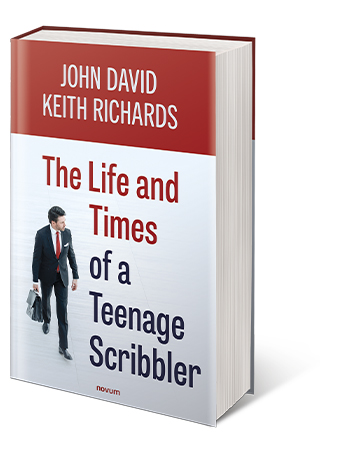
The Life and Times of a Teenage Scribbler
Hardcover | 396 pages
ISBN 978-3-99130-316-9
GBP 27.90
ORDER NOW